
Real‑Time Payments: A Complete Primer RTP, SEPA Instant, PIX & the New Logic of Instant Treasury (Vogue Boost Long‑Form, Narrative‑Driven Edition — Your Signature Style) The Shift No Operator Can Ignore Here’s the quiet truth shaping modern money movement: real‑time payments aren’t a feature anymore—they’re becoming the financial operating system beneath global commerce. In 2026, more than 80 countries now run domestic real‑time rails that settle funds in seconds, not days. For operators, this isn’t about speed. It’s about control—control over liquidity, control over cash timing, control over supplier obligations, payroll precision, and treasury posture. [ftc.gov] When money moves instantly, everything upstream and downstream reorganizes. This primer takes you inside the three rails that matter most—RTP (US), SEPA Instant (EU), and PIX (Brazil)—and the new treasury logic every founder, CFO, and operator must internalize. The Core Concept: What “Real‑Time” Really Means Across geographies, a true real‑time payment system has three non‑negotiable characteristics: Instant clearing—payment validated in seconds Immediate settlement—no pending, no batching Always‑on availability—24/7/365, including weekends and holidays This distinguishes real‑time rails from faster‑than‑ACH systems. A same‑day ACH payment isn’t “instant.” Real‑time rails confirm and settle in the same breath. [ftc.gov] RTP (United States): Liquidity at the Speed of Thought The RTP® network, operated by The Clearing House, is the U.S.’s most mature real‑time system. It’s built for scale and reliability—zero scheduled downtime, instant settlement, and transaction limits up to $10 million. [glenbrook.com] Since 2017, RTP has processed over $1 trillion, with participation now exceeding 1,130 financial institutions. [glenbrook.com] Why RTP Matters to Operators RTP is fundamentally a treasury tool: Precise payment timing Immediate confirmation Rich ISO 20022 data for reconciliation Predictable supplier and payroll disbursements This is the first system in the U.S. where a business can say:“Money leaves when I want it to leave. Money arrives when I need it.” That is liquidity management as a competitive advantage. [thepaypers.com] SEPA Instant (Europe): Pan‑European Instant Liquidity SEPA Instant Credit Transfer (SCT Inst) delivers real‑time payments across the Eurozone with a limit of €100,000 per transfer, settled in seconds. [mastercard.com] This is one of the rare cases where a region has aligned the incentives, regulations, and technical standards to support a single, interoperable, continent‑spanning instant rail. Why SEPA Instant Matters This is instant treasury across borders: Cross‑market liquidity consolidation Supplier payments anywhere in the Eurozone Uniform infrastructure, uniform rules For any business with multi‑country operations, SEPA Instant effectively compresses Europe into one liquidity zone, in real time. PIX (Brazil): Mass‑Market Instant Payments at Planetary Scale Launched in 2020, PIX is one of the fastest‑adopted real‑time payment systems in history. It has fundamentally reconfigured Brazil’s financial landscape. PIX processed tens of billions of instant transactions by 2024 and continues accelerating. [imali.app] Why PIX Matters PIX isn’t just a payment rail—it’s a behavioral shift: Near‑universal adoption QR‑based payments everywhere Instant merchant settlement Mandatory participation for major institutions PIX shows what happens when instant payments become a default, not an option:cash usage collapses, card fees come under pressure, and small businesses gain real‑time cashflow superpowers. How Real‑Time Payment Systems Actually Work Despite geographic differences, the workflow is nearly identical across RTP, SEPA Instant, PIX, FedNow, UPI, and others: Initiation – User triggers payment via bank, app, API Authorization – Funds, identity, fraud checks Network transmission – Payment routed instantly Clearing & settlement – Final within seconds Confirmation – Sender and receiver notified immediately This unified pattern explains why instant payments scale so effectively across borders. [mastercard.com] Instant Treasury: The Operator’s Advantage Real‑time payments don’t merely speed up transactions—they rewrite treasury fundamentals. 1. Liquidity Becomes Continuous With real‑time settlement: Cash concentration becomes dynamic Treasury no longer waits for bank hours Businesses can disburse funds at the last responsible moment This moves treasury from “managing float” to “orchestrating liquidity.” [thepaypers.com] 2. Real‑Time Receivables Transform Working Capital Immediate settlement means: Faster order fulfillment Reduced Days Sales Outstanding (DSO) Precise short‑term forecasting PIX and SEPA Instant have already demonstrated materially improved cash cycles for SMEs. [mastercard.com] 3. Automation Through Data RTP and SEPA Instant use ISO 20022, enabling: Automated reconciliation Clean audit trails Lower errors Rich metadata for treasury analytics RTP highlights real‑time reconciliation as a core feature. [glenbrook.com] 4. Treasury Must Now Operate “Always On” Instant rails require: 24/7 fraud monitoring Automated exception handling Systems that react in real time Legacy treasury processes—built for banking hours—don’t survive in this environment. The shift is already underway. [imali.app] A Comparative Snapshot System Limit Coverage Key Advantage RTP (US) Up to $10M [glenbrook.com] U.S. High‑value treasury payments SEPA Instant €100,000 [mastercard.com] Eurozone Pan‑EU real‑time liquidity PIX Varies Brazil Universal adoption + QR commerce The Operator’s Takeaway Real‑time payments aren’t speeding anything up—they’re compressing the financial world into a continuous system. RTP, SEPA Instant, and PIX each illustrate a different dimension of this shift: RTP shows instant liquidity at enterprise scale. SEPA Instant shows cross‑border interoperability in a unified region. PIX shows mass‑market instant adoption transforming a whole economy. If card payments digitized commerce, real‑time payments are now digitizing cashflow itself. This is the real unlock:Instant payments collapse the distance between decision and outcome.That’s the new operating advantage for the next generation of SMBs, platforms, and fintech infrastructure builders.
Agentic Commerce 101 for Beginners
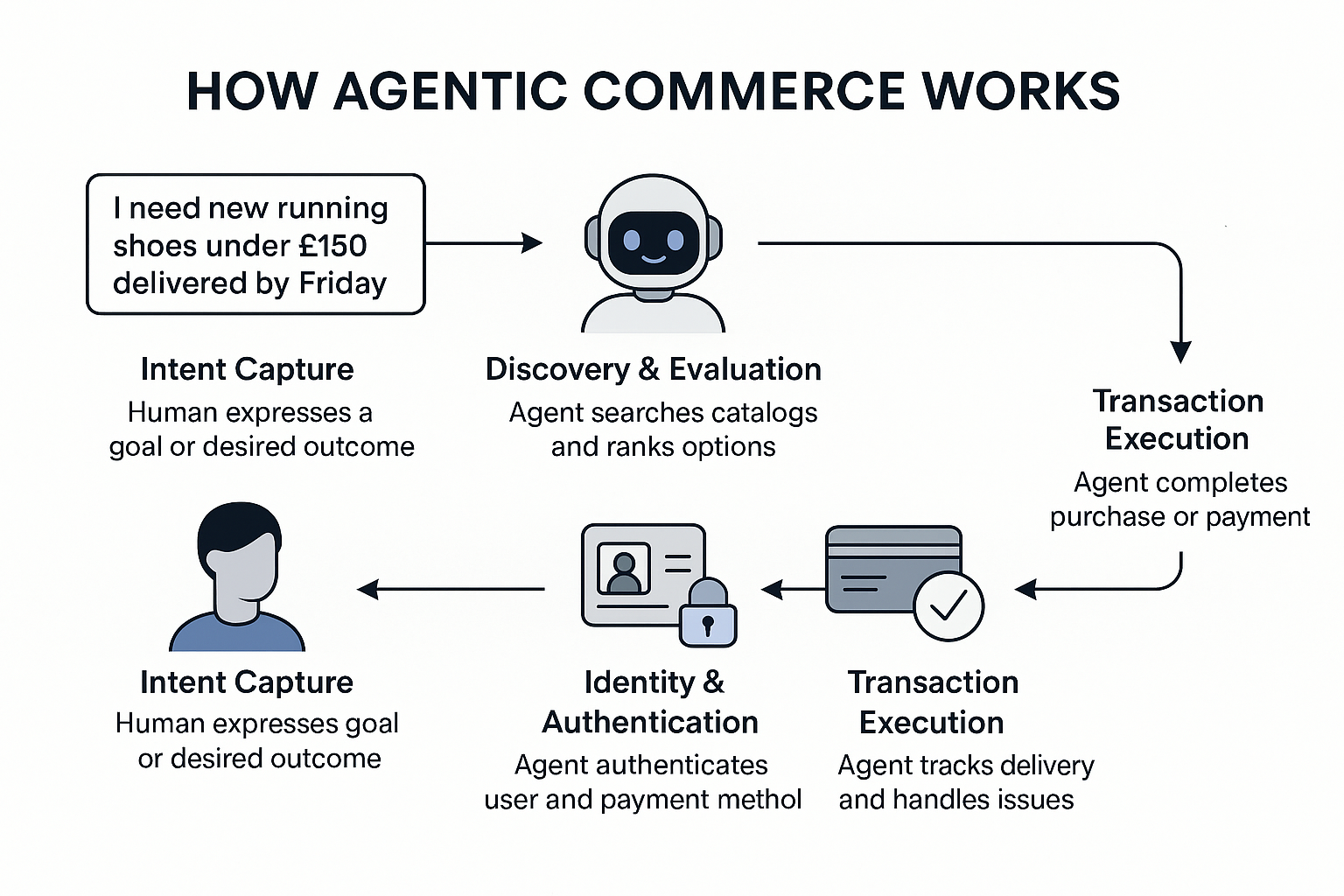
Agentic Commerce 101 for Beginners VogueBoost.com — FinTech Upskilling Series Agentic commerce is one of those shifts that sounds abstract until suddenly it feels inevitable. Much like the transition from desktop to mobile, or from cheques to instant payments, it starts with a small change in consumer expectations and then cascades into a fundamental redesign of the entire commercial stack. And as we step into 2026, it’s clear we are no longer at the “prediction” stage. The infrastructure is real, the adoption curves are rising, and both global platforms and small businesses are re‑architecting around it. To understand this shift, it helps to begin with the simplest possible framing: agentic commerce is what happens when people no longer shop — their agents do. McKinsey describes this new model as a “seismic shift,” one where AI agents don’t merely recommend products but actually anticipate needs, evaluate options, negotiate tradeoffs, and execute purchases with very little human intervention. It’s a step beyond e‑commerce, beyond chatbots, beyond “AI-powered search.” It’s a world where shopping becomes intent‑driven rather than task‑driven. A helpful way to picture it is to imagine giving a single instruction — “I need running shoes under £150 delivered by Friday” — and then stepping away. The agent interprets your intent, reviews merchant catalogs, compares prices and delivery windows, authenticates your identity, completes the transaction, and even manages the delivery or returns. As FinTech Futures notes, the key difference between agentic commerce and earlier “AI shopping assistants” is agency itself: these agents don’t just advise; they actually complete the workflow end‑to‑end. The signs are here for quite some time This shift isn’t happening in a vacuum. Over the last 24 months, we’ve seen the technical and commercial foundations assemble rapidly. Google launched its Universal Commerce Protocol in January 2026, opening a standard way for agents to interact with merchant data and perform purchases. Microsoft rolled out Copilot Checkout across the U.S. soon after. Shopify reported staggering growth — a fifteen‑fold increase — in orders initiated by AI-driven searches. Meanwhile, ChatGPT’s Agentic Commerce Protocol is now powering shopping interactions for its 900 million weekly active users. All of these developments, as nShift details, point toward a digital ecosystem that has quietly reorganized itself around machine-driven intermediaries. So what exactly is happening behind the scenes when an agent executes a purchase? The process begins with intention. Unlike legacy chatbots that respond to questions, agentic systems start with a goal: find me, decide for me, buy for me. FinTech Futures gives the simple example of a consumer specifying: “Find me shoes with blue stripes under $150,” and the agent taking responsibility for the entire subsequent workflow — discovery, evaluation, checkout, payment, even tracking. The user is no longer hunting through dozens of pages or worrying about form fields; they simply express constraints and desired outcomes. The discovery Once intent is defined, the agent begins discovery. This is where the dynamics of commerce fundamentally change. In the traditional model, discovery is mediated by scrolling, filtering, SEO, and advertising. But for an AI agent, browsing is not browsing — it’s a direct, structured sweep through inventory data, APIs, and realtime availability feeds. nShift calls the search bar “a tax on your customer’s time,” something agents remove entirely by filtering the entire commerce universe programmatically. That shift in behavior also means businesses must represent their offerings in structured, machine-readable ways or risk becoming invisible to the agents that are increasingly making purchase decisions. After the agent evaluates options, it must authenticate and transact. The mechanics here are increasingly standardized thanks to emerging interoperability frameworks. McKinsey highlights several of the major enabling protocols — the Model Context Protocol (MCP), Agent-to-Agent Protocol (A2A), Agent Payments Protocol (AP2), and Agentic Commerce Protocol (ACP). These standards together enable agents to exchange information, coordinate across systems, and, crucially, ride on the rails of existing digital commerce and payment networks. This means an agent doesn’t need a special “agent-only” checkout. It simply acts as a highly capable user moving through the same rails humans do — card payments, instant payments (RTP, SEPA Instant, Pix), bank transfers, and stablecoin rails. Once the transaction is done, the agent continues onward: tracking delivery, notifying the user, initiating returns, issuing refunds, or escalating support cases. This post‑purchase capability is especially emphasized in the newest analyses of agentic AI for SMBs, where autonomous systems can already resolve customer issues, modify shipments, send invoices, or update internal systems without human supervision. A new operating model If this sounds like an entirely new operating model, that’s because it is. And it introduces a major challenge for the market: the agentic readiness gap. As nShift explains, most retailers have spent years optimizing for discovery — SEO, ads, site design — but very few have optimized for agents that expect reliable data, trustworthy delivery, and structurally sound operational systems. Agents don’t have brand loyalty or sentiment; they evaluate merchants based on reliability signals that can be assessed instantly: delivery guarantees, stock accuracy, pricing consistency, refund policies, and frictionless integration. If a merchant’s data is poor or their fulfillment is inconsistent, the agent downranks them. Simply put: if your business isn’t machine-readable and machine-reliable, you are likely to vanish from the new purchase pathways. Beyond e‑commerce Beyond e‑commerce, the rise of agentic systems is having a transformative impact on SMB operations. The Rapid Architect report offers a vivid example: imagine walking into the office on Monday and finding your AI agent has already resolved dozens of customer inquiries, scheduled meetings, sent invoices, and flagged potential issues. This is not a hypothetical — it’s happening today. Autonomous agents represent a profound shift from passive AI tools to “executors” that complete multi-step tasks. Rather than responding to prompts, they pursue objectives. This makes them especially powerful for small teams that historically needed more staff to scale their operations. This evolution also creates new differentiation points in the market. According to BigCommerce, the platforms best positioned for this new world are those built on open, composable
A New Time of SMB Cyber Resilience: Why 2026 Marks a Turning Point in FinTech Security
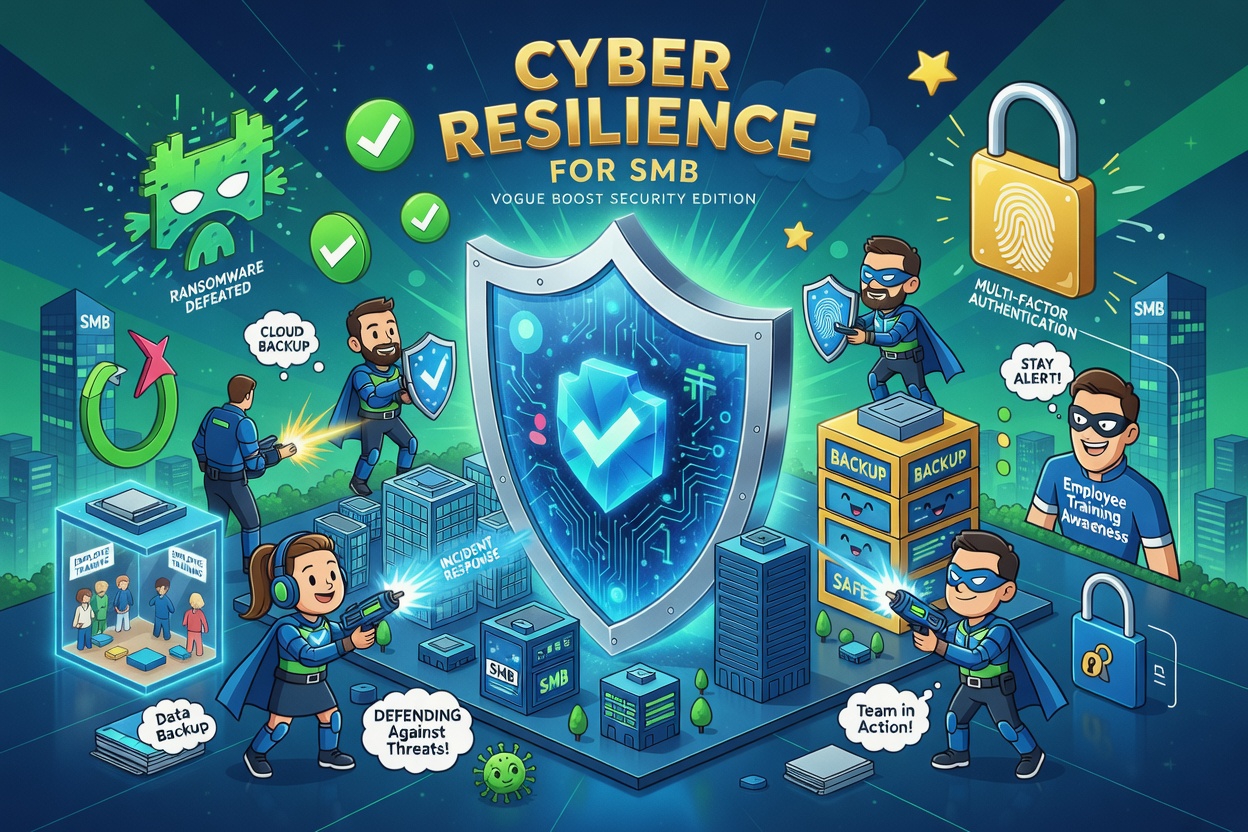
A New Time of SMB Cyber Resilience: Why 2026 Marks a Turning Point in FinTech Security In 2026, something profound is happening in the world of small business. The quiet assumption that “cybersecurity is an enterprise problem” has collapsed. For the first time, cybersecurity is moving from a technical afterthought to a front‑line financial decision for small and midsized businesses. And if you’re running an SMB—whether you’re a two‑person consultancy, a growing e‑commerce brand, or a 50‑person services firm—this shift will shape how you operate, compete, and defend your future. A landmark signal of this shift arrived earlier this year when Cloudflare and Mastercard announced a strategic partnership designed specifically to strengthen cyber resilience for small businesses. The initiative isn’t about adding yet another security tool; it’s about simplifying and unifying what has become a fractured, risky, and increasingly unmanageable digital footprint for SMBs. fintech.global(https://fintech.global/2026/02/18/cloudflare-and-mastercard-target-smb-cyber-risks/) This moment matters—not just because two industry giants are integrating capabilities, but because it highlights a deeper truth: FinTech is now inseparable from cybersecurity. And for SMBs, this alignment is reshaping how trust is built, how transactions happen, and how companies navigate risk in an AI‑first world. Let’s break down what is changing—and what SMBs must do next. 1. The Hidden Cyber Blind Spots SMBs Can No Longer Ignore Over the last decade, SMBs have embraced cloud tools, digital payments, automation apps, and distributed work. This rapid adoption has delivered massive productivity but has also quietly carved out a dangerous terrain: fragmented attack surfaces. Cloudflare and Mastercard’s partnership speaks directly to this problem. As businesses add vendors, outsource services, accumulate shadow IT, and rely on legacy systems, they unknowingly create digital assets that no one is monitoring. Mastercard’s Recorded Future and RiskRecon bring threat intelligence and third‑party risk data, while Cloudflare’s Application Security platform brings defensive capabilities—all in a unified system designed to illuminate these blind spots. fintech.global(https://fintech.global/2026/02/18/cloudflare-and-mastercard-target-smb-cyber-risks/) This isn’t merely technical. It’s financial.A single exposed domain, forgotten API gateway, or outdated plugin can lead to: Payment fraud Business email compromise Regulatory fines Customer churn due to trust erosion Liability claims—especially in industries handling sensitive data For SMBs, the stakes aren’t theoretical. A breach isn’t an IT problem; it’s a business continuity problem. 2. The Financial Meaning of Cybersecurity Has Changed 2026 marks the first year where cyber risk becomes a top‑three financial risk for SMBs, not because of fear—but because of economics. Three forces are converging: a. Attackers are using AI to automate exploitation As Cloudflare notes, attackers now probe systems continuously, using automated tools that test for vulnerabilities across thousands of potential entry points. The age of a “human hacker testing a door” is over. b. Regulatory pressure is rising globally From EU DORA enforcement to China’s AML monitoring rules to the UK’s updated safeguarding framework for payment institutions coming into force in May 2026, compliance expectations are tightening for firms of all sizes.SMBs, whether they intend to or not, are now part of regulated digital ecosystems. mambu.com(https://mambu.com/en/insights/articles/payments-regulation-in-2026-key-deadlines-and-events-to-watch) c. The adoption of digital payments & financial infrastructure is exploding SMBs now use more payment intermediaries, embedded finance tools, and AI‑driven systems. Each connection is both an enabler and a risk node. Cybersecurity is no longer “technical hygiene.” It is the new cost of doing digital business. 3. Why the Cloudflare–Mastercard Partnership Is a Blueprint for the Future SMB Stack The partnership introduces three major capabilities, each of which maps directly to SMB needs:fintech.global(https://fintech.global/2026/02/18/cloudflare-and-mastercard-target-smb-cyber-risks/) 1. Eliminating Blind Spots The system monitors a company’s entire digital presence, automatically discovering internet‑facing software stacks, domains, and misconfigured assets—especially those SMBs didn’t know existed. This is transformative because most SMB breaches start with “unknown unknowns.” 2. Real‑time Security Ratings Businesses receive an A–F graded security rating based on vulnerabilities, authentication weaknesses, exposed infrastructure, and third‑party risks. This rating becomes: A KPI for board or founder oversight A credibility marker for partners A negotiation tool for cyber‑insurance premiums A benchmark for continuous improvement For SMBs without a security team, this is equivalent to getting a live diagnostic of your risk posture. 3. One‑click Risk Mitigation Once risks are identified, Cloudflare’s controls—firewalls, automated defenses, access control policies—can be activated instantly. The value here is speed.In cyber, timing determines cost.A vulnerability open for 30 days is exponentially more dangerous than one closed within hours. This partnership therefore shifts SMB cybersecurity from reactive firefighting to proactive financial risk management. 4. Why SMBs Are Especially Vulnerable in 2026 A few industry dynamics make this year uniquely challenging. a. The attack surface is expanding faster than SMBs can manage Businesses adopting AI, automation, customer portals, or even simple website plugins multiply their exposure. b. Small businesses are targeted precisely because they lack resources Attackers understand that SMBs often lack dedicated security teams—and exploit that gap. c. Payments are increasingly digital—and increasingly attractive to attackers Everything from ACH transfers to embedded checkout flows introduces new fraud vectors. d. Supply‑chain breaches disproportionately hit SMBs Dependence on SaaS tools means an upstream vendor breach often becomes your breach. The Cloudflare–Mastercard model addresses these realities by treating SMBs not as oversized consumers, but as enterprises with real, multi‑layered risk. 5. The New SMB Security Playbook for 2026 (Actionable Steps) Inspired by the insights from the partnership and broader FinTech trends, here is the Vogue Boost SMB Security Playbook for the year ahead: Step 1: Map Your Digital Footprint If you don’t know everything that connects to your business, you can’t protect it. Action: Conduct a digital asset inventory—domains, plugins, SaaS apps, APIs, vendors. Step 2: Implement Continuous Threat Visibility Tools that scan once a year are outdated. SMBs need real‑time monitoring. The Cloudflare–Mastercard model is one example, but whichever system you choose, make sure it includes: External attack surface monitoring Third‑party risk scanning Vulnerability prioritization Step 3: Shift From Perimeter Security to Zero Trust‑Like Policies Every device, employee, vendor, and connection must be verified continuously. This doesn’t require enterprise budgets—just smart adoption of: Multi‑factor authentication Identity access management Least‑privilege access controls Step 4: Treat Cybersecurity as
Why Gen Z Small‑Business Owners Still Rely on Cash — And What FinTech Must Fix Next
Why Gen Z Small‑Business Owners Still Rely on Cash — And What FinTech Must Fix Next Over the last decade, the global FinTech ecosystem has focused intensely on creating sleek, frictionless digital experiences—instant consumer payments, app‑based banking, personal credit algorithms, automated savings, and AI‑driven financial coaching. Yet when you examine how Gen Z small‑business owners actually run their companies, a surprising pattern emerges. Despite being the most digital‑native generation in history, Gen Z founders continue to lean heavily on cash transactions. Mastercard’s recent insight confirms that 52% of payments made by Gen Z SMBs are still in cash, far higher than what anyone expected from the generation raised on mobile wallets and tap‑to‑pay convenience. stocktitan.net(https://www.stocktitan.net/news/TRV/simply-business-wins-smb-insur-tech-solution-of-the-year-in-fin-tech-ucd4be2v95kg.html) But the shock doesn’t end there. Only 20% of Gen Z entrepreneurs currently have a business credit card, a number largely driven by thin‑file credit histories that block access to traditional financing channels. stocktitan.net(https://www.stocktitan.net/news/TRV/simply-business-wins-smb-insur-tech-solution-of-the-year-in-fin-tech-ucd4be2v95kg.html) It’s easy to assume this is a preference issue or a generational quirk. In reality, it reveals something deeper about the state of SMB financial infrastructure—and the gaps FinTech still hasn’t solved. In this Vogue Boost long‑form signal, we unpack why Gen Z relies on cash, what this says about SMB financial tools, and where the biggest opportunities lie for founders, operators, and FinTech builders. The Digital Paradox: The Most Online Generation Is Still Operating Offline On the surface, Gen Z’s relationship with money is profoundly digital. They pay friends instantly, use mobile banking as their default interface, deploy budgeting apps, and treat digital wallets as an extension of their identity. Yet when they step into the world of entrepreneurship, the landscape looks very different. Mastercard’s findings highlight the paradox: the same entrepreneurs who run their personal lives digitally are running their businesses in a surprisingly manual way. Cash is used because it offers immediacy, liquidity, and complete certainty at the point of transaction. stocktitan.net(https://www.stocktitan.net/news/TRV/simply-business-wins-smb-insur-tech-solution-of-the-year-in-fin-tech-ucd4be2v95kg.html) Why does this matter? Because it reveals a core truth about financial tools that support SMBs today:consumer FinTech is vastly more advanced than SMB FinTech. Gen Z is not resisting technology. They are compensating for financial infrastructure that does not meet their operational realities. The Structural Problem: SMB Financial Infrastructure Hasn’t Caught Up This isn’t about resisting modernity. It’s about solving practical problems. For Gen Z founders, cash solves three critical needs: 1. Instant Liquidity Small businesses—particularly new ones—operate on razor‑thin margins. Cash ensures that funds are available immediately, without settlement delays, batching windows, or pending statuses that can interrupt operations. 2. Certainty and Control Digital payments often introduce ambiguity. When will funds land? Is a payout delayed? Is the platform holding reserves? Cash eliminates uncertainty, allowing Gen Z founders to stay in control. 3. A workaround for broken or inaccessible credit infrastructure With only 20% of Gen Z SMBs holding a business credit card, many founders experience a liquidity gap that digital systems cannot fill. stocktitan.net(https://www.stocktitan.net/news/TRV/simply-business-wins-smb-insur-tech-solution-of-the-year-in-fin-tech-ucd4be2v95kg.html) Meanwhile, consumer FinTech has become incredibly mature—instant peer‑to‑peer transfers, real‑time alerts, transparent timelines. SMB FinTech, however, remains fragmented, slow, and often designed around legacy systems. This disparity forces Gen Z entrepreneurs into analog behaviors, even when they would prefer digital tools. The Cash Reality: What Mastercard’s Findings Really Tell Us To understand the broader context, consider Mastercard’s perspective:Gen Z’s dependency on cash stems not from nostalgia but from practicality. Cash remains a fast solution to immediate liquidity needs. It ensures smooth day‑to‑day operations in environments where digital tools introduce friction or fail to meet baseline expectations for reliability. stocktitan.net(https://www.stocktitan.net/news/TRV/simply-business-wins-smb-insur-tech-solution-of-the-year-in-fin-tech-ucd4be2v95kg.html) Mastercard’s analysis makes something else clear:SMB financial infrastructure is the lagging piece of the FinTech puzzle. Consumer FinTech has sprinted ahead. SMB FinTech has limped behind. The digital divide between personal finance tools and business finance tools is widening, and it directly shapes how young entrepreneurs behave. Gen Z’s Expectations: What Young Founders Actually Want from FinTech If FinTech wants to shift this behaviour, it must focus on how Gen Z defines value. Young founders expect: Real‑time movement of money Predictable settlement timelines (no uncertainty windows) Clear, real‑time visibility into liquidity Tools that integrate directly with their workflows Credit products designed for thin‑file applicants When these expectations are unmet, cash wins by default because it is simple, transparent, and immediate. For Gen Z founders, financial tools are not about brand familiarity or loyalty. They’re about operational dependability. A Wider View: How Cyber and Infrastructure Friction Compounds the Problem Zooming out, broader ecosystem shifts reinforce the need for simpler, more reliable financial processes. For example, cyber‑risk complexity for SMBs has increased significantly as they expand their digital footprint. Cloudflare and Mastercard’s partnership reveals the scale of blind spots SMBs face as they adopt more digital tools, integrations, and vendors. The collaboration aims to help small businesses identify and mitigate hidden cyber exposures that accumulate as they adopt cloud services and third‑party software. pymnts.com(https://www.pymnts.com/smbs/2026/mastercard-warns-credit-gap-is-holding-back-gen-z-small-businesses/) This reinforces a core point:the more complex digital operations become, the more SMBs gravitate toward methods that feel simple and trustworthy—like cash. The challenge for FinTech is not just usability. It’s building tools that deliver reliability, control, and clarity in environments where digital complexity is growing. Practical Guidance for SMB Owners Navigating Today’s Financial Tools Free or higher Membership Required. More content is available after subscription. FREE Membership Available. You must be a Free OR Paid member to access this content. View Membership Levels If you’re a small‑business owner, especially a first‑time Gen Z founder, here’s a practical roadmap to modernizing your financial operations without losing the dependability you associate with cash. 1. Map Your Cash‑Flow Friction Points Before migrating to digital tools, identify exactly where things break down. Is the issue payout timing? Fees? Delayed settlements? Reconciliation overhead? Understanding friction points helps you choose tools that genuinely improve operations. 2. Prioritize Certainty Over Novelty Don’t be swayed by flashy features. Choose platforms that offer: Guaranteed payout times Real‑time transaction data Transparent settlement policies Certainty is more valuable than optional extras. 3. Start Building a Thin‑File Credit Profile Early Because only 20% of Gen Z SMBs
Decoding the Silent Revenue Killer: Infographic
Churn-Shield Benchmark Report | Interactive Infographic ⯈ ChurnShield Benchmarks Root Causes Risk Matrix Framework 2026 Intelligence Report Decoding the Silent Revenue Killer Customer churn isn’t just a metric; it’s a compounding leak in your business model. Explore the definitive benchmark data to understand why customers leave and how to build an impenetrable retention shield. 14.2% Average SMB Churn $2.4M Avg Annual Lost Revenue 68% Categorized as Preventable The Industry Baseline Before implementing defensive strategies, it is crucial to understand the macroeconomic landscape. The chart below illustrates the average annual churn rates across distinct business sectors. This data serves as the baseline against which you should measure your own retention performance. High-velocity transactional businesses naturally experience higher turnover than integrated enterprise solutions. Annual Churn Volume by Sector Percentage of customer base lost annually across key SMB verticals. ➤ B2B SaaS Resilience: Operating at the lowest churn tier (5.8%), B2B SaaS benefits from high integration costs and subscription-based friction, making them highly resilient to impulse cancellations. ➤ Retail Volatility: Retail and E-commerce face extreme volatility (24.5%) due to near-zero switching costs and hyper-competitive market saturation. Anatomy of Defection Identifying the volume of lost customers is only the first step. To build an effective shield, we must dissect the why. Our analysis categorizes churn into five primary drivers. Notably, the majority of churn is not driven by product failure or pricing, but by experiential friction during the customer lifecycle. The visualization below breaks down these root causes. Primary Drivers of Cancellation 🚩 The Onboarding Failure (38%) The absolute largest driver of churn. If a user does not achieve their “first value” within 14 days of acquisition, the probability of churn triples. They leave because they never understood how to win using your product. 💬 Support Friction (24%) Customers expect issues; they do not tolerate prolonged resolution times. Forcing customers to repeat their problems across multiple channels is a primary catalyst for immediate cancellation. 💸 Value Degradation (18%) Often mislabeled as “too expensive.” Customers leave when the perceived return on investment dips below the subscription cost over time due to a lack of continuous feature adoption. The Health Risk Matrix Proactive retention requires identifying at-risk accounts before they cancel. By plotting a cohort of users based on their internal Health Score against their Monthly Recurring Revenue (MRR), we reveal the hidden danger zones. The bubble chart below illustrates this relationship. Accounts in the upper-left quadrant represent critical revenue at imminent risk of loss. ↑ High Value ← High Risk Account Vulnerability Correlation Bubble Size = Relative Account Age. Left = Danger Zone. The Mitigation Framework Data without action is mere trivia. Based on the behaviors of top-quartile retention organizations, we have synthesized a three-stage architectural framework to halt defection. Implement these procedural steps to transform your customer lifecycle from a leaky funnel into an expanding revenue engine. 01 Accelerate First Value Restructure the first 30 days. Shift focus from product tutorials to specific outcome achievements. ✓ Mandatory Guided Onboarding ✓ Measure ‘Time-to-Value’ strictly ✓ Proactive Day-14 check-in calls 02 Predictive Intervention Move support from reactive troubleshooting to proactive health monitoring and immediate outreach. ✓ Implement dynamic Health Scores ✓ Alerts for 7-day usage drops ✓ Empower agents with instant credit 03 Continuous ROI Proof Never assume the customer remembers why they bought. Prove the value continuously. ✓ Automated Monthly Value Reports ✓ Quarterly Business Reviews (QBRs) ✓ Exclusive access for tenured clients Stop the leak. Secure the revenue. Download Full Executive Brief © 2026 Churn-Shield Analytics. Generated for Interactive Infographic Demo.
The Global FinTech Landscape in 2026: The Era of Cognitive Automation, Tokenized Value, and Regulatory Maturity
FinTech Trends 2026: Report With Case Studies
FinTech Trends 2026: Infographic
Explore more from the FinTech Trends 2026 Stack: Infographic Comprehensive Research Report Comprehensive Research Report PDF (download pdf) FinTech Trends 2026: Report With Case Studies FinTech Trends 2026: Report With Case Studies (download pdf) Listen / Download Audio Overview Play Interactive FinTech Trends 2026: FinTech 2026: The Age of Invisible Finance FINTECH2026 Market Growth Payments AI & Auto Tech Matrix The Age of Invisible Finance By 2026, banking will no longer be a place you go, but something you do effortlessly. Explore the data behind the transformation. $375B Market Size 85% AI Adoption 40% Embedded Tx Global Outlook Unstoppable Momentum The global FinTech sector is defying economic headwinds. Driven by emerging markets in LATAM and APAC, combined with the maturation of blockchain and embedded finance infrastructure, the market is projected to surge past $375 Billion by the end of 2026. Key Takeaway Traditional banking revenue pools are migrating to tech-first challengers at a rate of 4% per year. The growth curve indicates a shift from “disruption” to “dominance.” Projected Market Size (USD Billions) The Death of Plastic? By 2026, the physical wallet becomes obsolete. Biometric authentication (palm, face) and Digital Wallets are set to overtake traditional cards. Cash usage drops to historical lows as “Invisible Payments” take over. Projected Share of Transaction Volume (2026) 🖐️ Biometric Surge High Growth Palm and face scanning payments are growing at 32% CAGR. Security and convenience are driving mass adoption in retail. 📱 Super Wallets Dominant Apple Wallet, Google Pay, and regional Super Apps are becoming the primary interface for 60% of consumers, relegating banks to the backend. 💶 Cash Decline Declining Physical currency usage projected to drop below 10% of total transaction volume in developed economies. The “Invisible” Loan Process Embedded Finance means loans happen at the point of need (e.g., buying a car), not at a bank branch. Here is the 2026 workflow powered by Real-Time Data. 🛒 Trigger Event Customer selects item on e-commerce site or dealership. 📡 Data API Platform pulls Open Banking data & history instantly. 🤖 AI Decision Risk model approves credit in < 200 milliseconds. ✅ Execution Funds embedded directly into the purchase flow. Hyper-Personalization By 2026, “Generic Banking” is dead. AI analyzes spending habits, predicts cash flow gaps, and auto-invests surplus funds. Predictive Alerting: Warning users of overdrafts 3 days before they happen. Autonomous Switching: AI moves money to higher interest accounts automatically. Consumer Trust in AI Advisory Technology Maturity Matrix Analyzing Impact vs. Adoption vs. Risk for 2026 Technologies Interaction: Rotate, Zoom, and Hover over points to explore the data. Regional Hotspots While North America stabilizes, Asia Pacific and Africa are leapfrogging traditional banking entirely, adopting mobile-first DeFi solutions at unprecedented rates. APAC +24% YoY LATAM +19% YoY EMEA +12% YoY North America +8% YoY FinTech Adoption Rate (%) FINTECH2026 Synthesized analysis of global financial technology trends, market projections, and consumer behavior shifts. Data Sources Global Market Insights 2025 Future of Payments Report AI in Banking Survey Q4 Generated By Canvas Infographics AI Note: All data points are illustrative projections based on current trend analysis for the year 2026.
FinTech Trends 2026
Explore more from the FinTech Trends 2026 Stack: Infographic Comprehensive Research Report Comprehensive Research Report PDF (download pdf) FinTech Trends 2026: Report With Case Studies FinTech Trends 2026: Report With Case Studies (download pdf) Listen / Download Audio Overview Play Interactive FinTech Trends 2026: FinTech 2026: Strategic Outlook FinTech2026 Strategic Foresight Report 📊 Executive Summary 📈 Market Dynamics 👤 Consumer & Payments 🤖 Tech Infrastructure Current Context Global Overview FinTech2026 OverviewMarketConsumerTechnology The Age of Invisible Finance By 2026, financial services will largely disappear into the background of daily life. This report synthesizes key trends driving the $375B shift towards autonomous, embedded, and hyper-personalized finance. Market Size 2026 $375B ▲ 20.5% CAGR Strong Momentum AI Interactions 85% Of all banking customer service & advice will be autonomous. Embedded Tx 40% Payments processed by non-banks (retailers, car makers). Executive Takeaway Traditional banking pools are eroding. The winners in 2026 won’t be those with the most branches, but those with the most seamless API integrations and the most predictive AI models. Explore Market Data Top 3 Disruptors ● Autonomous Finance agents ● Biometric Payments ● Post-Quantum Security Global Market Dynamics Analyzing the trajectory of fintech valuation and regional adoption rates through 2026. Projected Valuation Growth USD Billions *Projections based on 20.5% Compound Annual Growth Rate (CAGR). Regional Adoption Hotspots While North America stabilizes, APAC and Africa are leapfrogging legacy systems. Insight “The fastest growth isn’t in replacing banks, but in enabling non-financial companies to act like them.” The Changing Consumer How people pay, save, and trust technology is undergoing a fundamental shift. Wallet Share 2026 Projected % of Transaction Volume Trust in Autonomous Finance Consumer willingness to let AI manage funds AI Auto-Switching Savings 68% Approval Technology Matrix Visualizing the infrastructure powering the next generation of finance. Innovation Impact Analysis X: Adoption Time | Y: Business Impact | Size: Implementation Risk Interactive: Hover for details The “Invisible” Loan Architecture 🛒 Trigger User buys car/item on non-bank platform. 📡 Data API Instant pull of credit history & cash flow. ⚡ AI Decision Risk assessed in < 200ms. 💰 Execution Funds embedded in checkout flow.
How Barclays Used Open Banking APIs to Innovate Faster — And What SMBs Can Learn From It
For years, big banks have carried the reputation of being slow, rigid, and weighed down by legacy systems. Meanwhile, fintech challengers seemed to ship new features every month, delighting customers with fast onboarding, transparent pricing, and seamless mobile experiences. But Barclays quietly proved something important: Speed isn’t a fintech advantage.Speed is an architectural advantage. And architecture can be changed. Open Banking APIs gave Barclays the unlock they needed — not to rebuild their entire tech stack, but to modernize how innovation happened inside the bank. Instead of trying to out‑build younger competitors, they learned how to out‑partner them. This blog post breaks down how they did it — and how SMBs can use the same playbook today. The Problem: Great Teams, Slow Systems Inside Barclays, the biggest challenges weren’t talent or ambition — they were friction. Teams knew what they wanted to build.They just didn’t have the structural ability to ship fast enough. This wasn’t a “bank problem.” It’s a problem any business faces when systems, tools, or processes slow down execution. The Industry Shift: Why APIs Became the Answer Open Banking regulations (PSD2, UK OBIE) required banks to provide secure access to accounts and payments through APIs. Most banks treated this as a compliance headache. Barclays treated it as a strategic unlock. APIs offered: Instead of building every feature internally, Barclays realized they could connect to specialist fintech capabilities and deliver better outcomes faster. It was a shift from: “We must build everything ourselves” → “We must orchestrate the best capabilities.” What Barclays Actually Did Free or higher Membership Required. More content is available after subscription. FREE Membership Available. You must be a Free OR Paid member to access this content. View Membership Levels 1. Built a high‑quality API foundation Clean documentation, secure authentication, reliable uptime, clear scopes, developer sandboxes. 2. Exposed high‑value APIs first These unlocked immediate value. 3. Partnered with fintech specialists For example, using experts for cross‑border transfers, identity flows, and mobile-first experiences. 4. Redesigned consent journeys for trust Clear, simple, reversible, safe. 5. Implemented integrations in weeks, not months APIs reduced heavy internal work and made innovation more plug‑and‑play. 6. Launched high‑impact use cases 7. Used data to iterate and scale Monitoring dashboards turned API innovation into a continuous improvement loop. The result? Barclays began moving like a fintech — without losing the trust of a bank. The Results: Faster, Safer, Simpler Banking 1. Faster product delivery Long roadmaps shrank.Teams could ship again. 2. Better customer experiences 3. Lower operational friction 4. Stronger risk management Bank‑verified data and compliant APIs meant safer flows, not riskier ones. 5. Lower long‑term cost Building less → maintaining less → shipping faster. 6. A stronger competitive position Barclays gained relevance in a fintech‑centric market — without trying to become a fintech. What SMBs Can Learn From Barclays Even if you’re not a bank, the lessons apply directly. 1. Don’t build everything internally. Leverage best‑in‑class tools via APIs. 2. Fix the friction, not the symptoms. Most “growth problems” are really “friction problems.” 3. Architecture determines speed. Systems that can’t talk to each other slow everything down. 4. Partnerships create leverage. You don’t need to be the best at everything — just connect to what is. 5. Start small and scale. Barclays began with a few high‑impact use cases. So can you. 6. Compliance and trust are assets. Design trust into every flow. 7. Optionality beats ownership. The more modular your stack, the faster you can move. How to Apply This Today (Simple Playbook) Here’s a practical way any SMB can copy Barclays’ strategy: Step 1 — Identify your slowest, highest-friction workflow.Step 2 — Find a specialist tool that solves it via API.Step 3 — Integrate a single workflow (don’t overhaul everything).Step 4 — Measure the before/after impact.Step 5 — Improve one more workflow.Step 6 — Repeat until your operations feel “light.” Small wins compound. Final Thought Barclays didn’t transform by “trying to be innovative.”They transformed by changing the structure that made innovation slow in the first place. APIs gave them: It wasn’t a digital transformation program.It was an architectural upgrade that empowered everyone — operators, customers, and partners. And the best part? Any SMB can use the same playbook today.