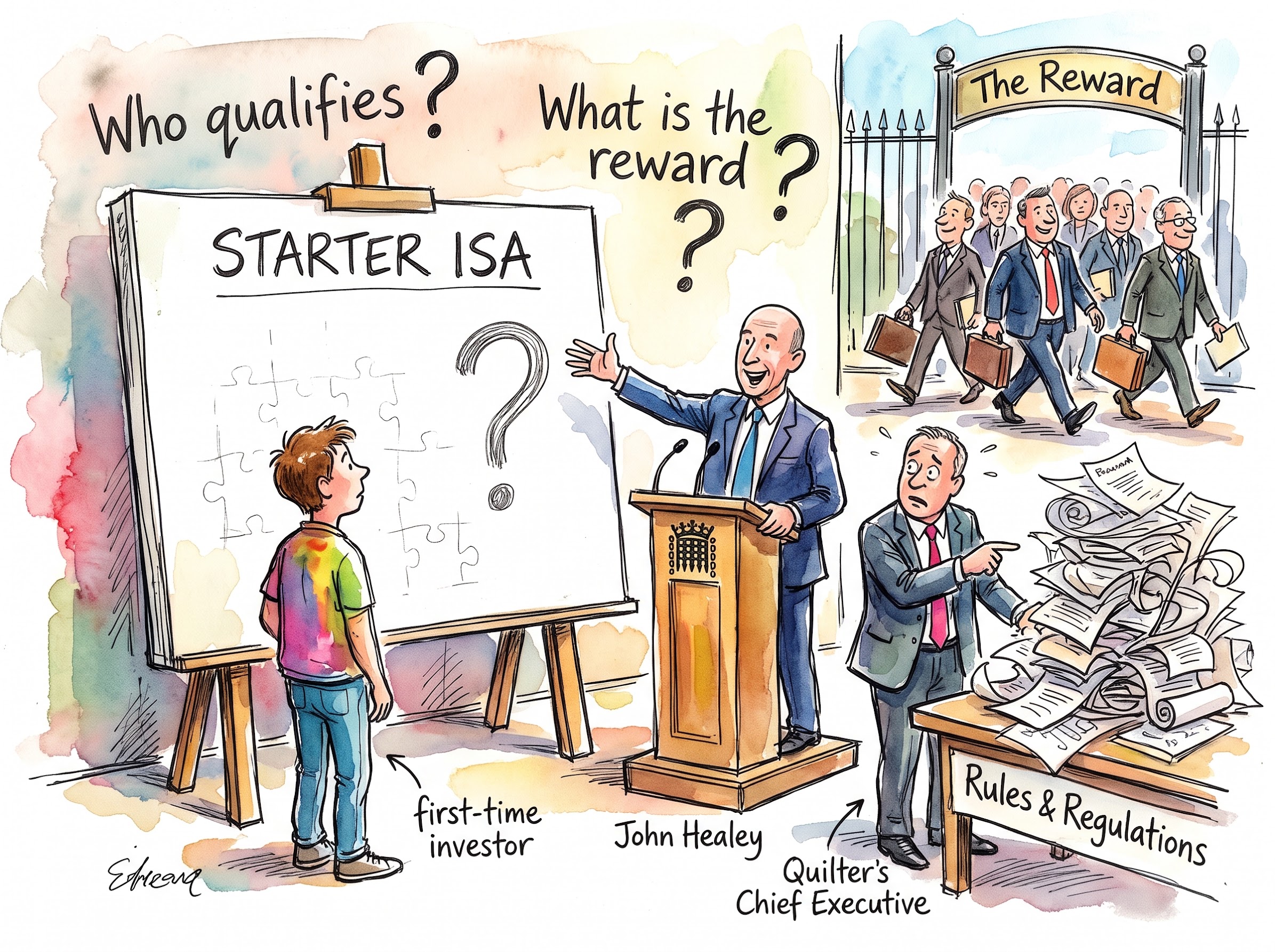
John Healey promised a new Starter ISA on Wednesday to reward first-time investors. He provided zero details on who qualifies or what the financial reward might be. Quilter’s chief executive was quick to point out that this just hands retail customers yet another rulebook to decipher. He has a point. The danger of launching a product name before the policy is that the blank space gets filled by default industry thinking. If this account is built around the technical architecture that investment platforms find easy to administer, it will completely miss the demographic it is supposed to help. It will end up subsidising the first steps of someone who was about to open an account on Hargreaves Lansdown anyway. We have been here before with government attempts to engineer retail financial behaviour. The Help to Buy ISA was a masterclass in good intentions colliding with market reality, creating a system where the bonus could only be triggered at completion—the exact moment when a buyer needed the cash for the deposit, not the final conveyancing bill. The Lifetime ISA (LISA) is another casualty of complexity. It offers a generous 25% top-up, yet it sits wrapped in an access penalty so punitive that it actively frightens away the very people it was designed to encourage. The Starter ISA risks walking into the same trap. Whenever the Treasury attempts to intervene in retail savings, the resulting product usually carries the distinct fingerprint of a Whitehall committee trying to guard against every conceivable edge case. They worry about wealthy parents gaming the system for their children. They worry about day-traders pocketing the bonus. The resulting rulebook becomes a fortress. But a fortress is exactly what a reluctant saver does not need. At the moment, the Cash ISA allowance remains untouched at £20,000. People sitting on large cash balances usually aren’t doing it to optimise their tax position. They hold cash because it feels safe, while the stock market feels like a high-stakes exam they haven’t studied for. The psychological barrier to investing isn’t a lack of tax wrappers. We already have the Stocks and Shares ISA, the LISA, and the Junior ISA. The barrier is a deep-seated conviction that investing is something other people do—people with more money, more time, and a higher tolerance for watching a line on a graph go down. Offering a £50 opening bonus won’t bridge that confidence gap if getting the money requires navigating a 12-page disclosure on qualifying periods. The person willing to read page 12 is already an investor. They are already comfortable with the language of key investor information documents and platform fees. The Starter ISA should not be designed for them. If the goal is to shift capital from low-yielding cash deposits into productive assets, the target audience is the person staring at £4,000 in a high street savings account earning 3.2%. They know inflation is eating it, but they don’t know what else to do. To reach them, the Starter ISA has to look and feel entirely different from the legacy infrastructure of the wealth management industry. It cannot require a degree in financial planning to understand. It must borrow the friction-free onboarding of consumer tech without adopting its gamification of risk. There is time to get this right. The fact that the Budget speech left the mechanics entirely blank is an opportunity. The Treasury and the sector are designing this from scratch. They need to build it as a straightforward retail promotion, stripping out the conditional clauses that usually kill these initiatives at birth. A flat cash match on the first £1,000 invested is something a normal saver can weigh against a standard deposit rate. It is a tangible, immediate reward for crossing the Rubicon into equities. It makes the math simple: put in £1,000, get £100. That is an incentive structure that survives a 10-second glance on a mobile screen. Crucially, the eligibility check must be a single tick-box. If the criteria require digging out a decade of old share-dealing records to prove you are a strict “first-time” investor, the drop-off rate will be near total. The platform providers cannot be asked to become forensic auditors of their customers’ financial history. The friction of the KYC (Know Your Customer) process is already high enough. Adding a retroactive purity test for investment virginity will simply mean the platforms won’t bother pushing the product. The industry response so far has been predictably cautious. Platform chief executives are understandably wary of being handed a mandate to educate a new cohort of investors without the budget to do so, especially under the watchful eye of the FCA’s Consumer Duty regulations. They know that novice investors are expensive to acquire, quick to panic during market corrections, and resource-intensive to support. This is where the structure of the Starter ISA becomes critical. It cannot just be an empty tax wrapper; it needs default settings that protect the user from themselves. We know from the success of auto-enrolment in workplace pensions that inertia is the most powerful force in personal finance. The Starter ISA should weaponise that inertia. Instead of presenting a new investor with a bewildering supermarket of 3,000 funds, ETFs, and single stocks, the product should default into a globally diversified, low-cost index tracker. If we want to build a culture of long-term investing, we have to stop treating the initial allocation decision as a test of financial literacy. The cognitive load of choosing between a UK equity income fund and a global technology ETF is precisely what drives people back to the safety of a Cash ISA. Make the default choice the right choice. Let them opt out into single-stock picking if they really want to, but make the path of least resistance a sensible, diversified portfolio. There is a broader macroeconomic argument here, too. The UK has a chronic problem with retail capital formation. Compared to our peers in the US or Australia, British households hold a disproportionate amount of their wealth in residential

Nobody told him this was available to him
Nobody told him this was available to him John is a boat engineer. He designs the structures that keep vessels seaworthy — load, resistance, water pressure, the kind of work where “close enough” doesn’t hold up. We spent several weeks talking about his business before we talked about money at all: harbours, jurisdictions, a satellite connection that only ran in maritime mode. Somewhere in that conversation he went quiet, asked two precise questions, and then said something I haven’t stopped turning over since. “I didn’t know this was available to me.” He’d just realised that a professional life spent moving between countries and connectivity zones wasn’t only a source of friction. It was also, understood correctly, a source of financial options a business fixed to one office in one country doesn’t get. Nobody had hidden this from him. Nobody had ever framed his financial world in terms that connected to his actual life, so he’d spent years managing it the way you manage weather — absorbed, worked around, not thought about more than necessary. That’s a rational response to a bad offer. It’s also the most expensive decision most competent business owners make, and they make it without noticing. The UK keeps treating this as an information problem — a gap to be closed with a leaflet, a workshop, a “financial capability” module bolted onto onboarding. FutureDotNow puts the annual value of closing the UK workforce’s digital skills gap at £23 billion, a careful, well-sourced figure worth taking seriously on its own terms. Financial comprehension sits next to it, larger, and nobody has costed it at all. Parliament has just legislated a Financial Inclusion Strategy — November 2025 — and pencilled in primary-school financial literacy for 2028. That’s four more years of the current arrangement, for children who won’t be running businesses for another decade. It isn’t that owners lack information. Most could define APR without blinking. What they lack is permission to think of financial fluency as something that belongs to them rather than something they’re behind on — and the entire architecture of financial education, from the school savings passbook onward, has been built to communicate the opposite. (Somewhere in most banks’ compliance departments there’s a jargon glossary — “what is EBITDA,” that sort of thing — commissioned with good intentions and read, if the analytics are honest, by almost nobody. It’s the inclusion model in miniature: keep the language exactly as it was, offer a dictionary, call it generosity.) The gap has also changed shape underneath everyone. The Department for Science, Innovation and Technology’s research puts deliberate AI adoption among UK SMBs at around 16%. Ask a different question — how many are using AI at all, embedded in the accounting software, the payments platform, the CRM that quietly added a scoring feature eighteen months ago — and the figure is closer to 70%. Most owners running AI-assisted businesses don’t know they are. Nobody voted on the sequence by which their bookkeeping software started deciding which invoices to chase first. It just accreted, release note by release note, until it was load-bearing. The Financial Conduct Authority’s Consumer Duty, in force since July 2023, now obliges firms to support customer understanding rather than simply disclosing information and hoping it lands. That’s a genuine shift, and firms have spent two years building the compliance architecture around it. Whether it produces an owner who can read their own merchant statement is still an open question, and open questions administered thoroughly are not the same as urgency. None of this is a case against the technology. Open banking, live since January 2018, and algorithmic underwriting have done things a paper-based system never could. The problem sits one layer up, in who gets shown how any of it works, and on whose terms. Waiting for government to close that gap has an obvious cost, which is time nobody currently short of financial fluency has to spare. The businesses with the most direct stake in fixing it — and the most direct evidence of what its absence costs them — are the ones best placed to do it now, without a 2028 deadline. John messaged three weeks after our conversation. He’d found a tax adviser who specialised in maritime professionals. He’d restructured his invoicing — legally cleaner, operationally simpler than what he’d been doing for years. He’d found two AI tools that actually ran on maritime satellite, tools he’d never turned up before because he’d been searching the general market instead of his own. He said he’d started looking at his finances the way he looks at a boat: a structure with specific loads, which can be understood, and therefore steered. He supplied that metaphor himself, after the fact, better than I would have.
Visa–Mastercard interchange settlement clears court — merchant fee structure changes ahead
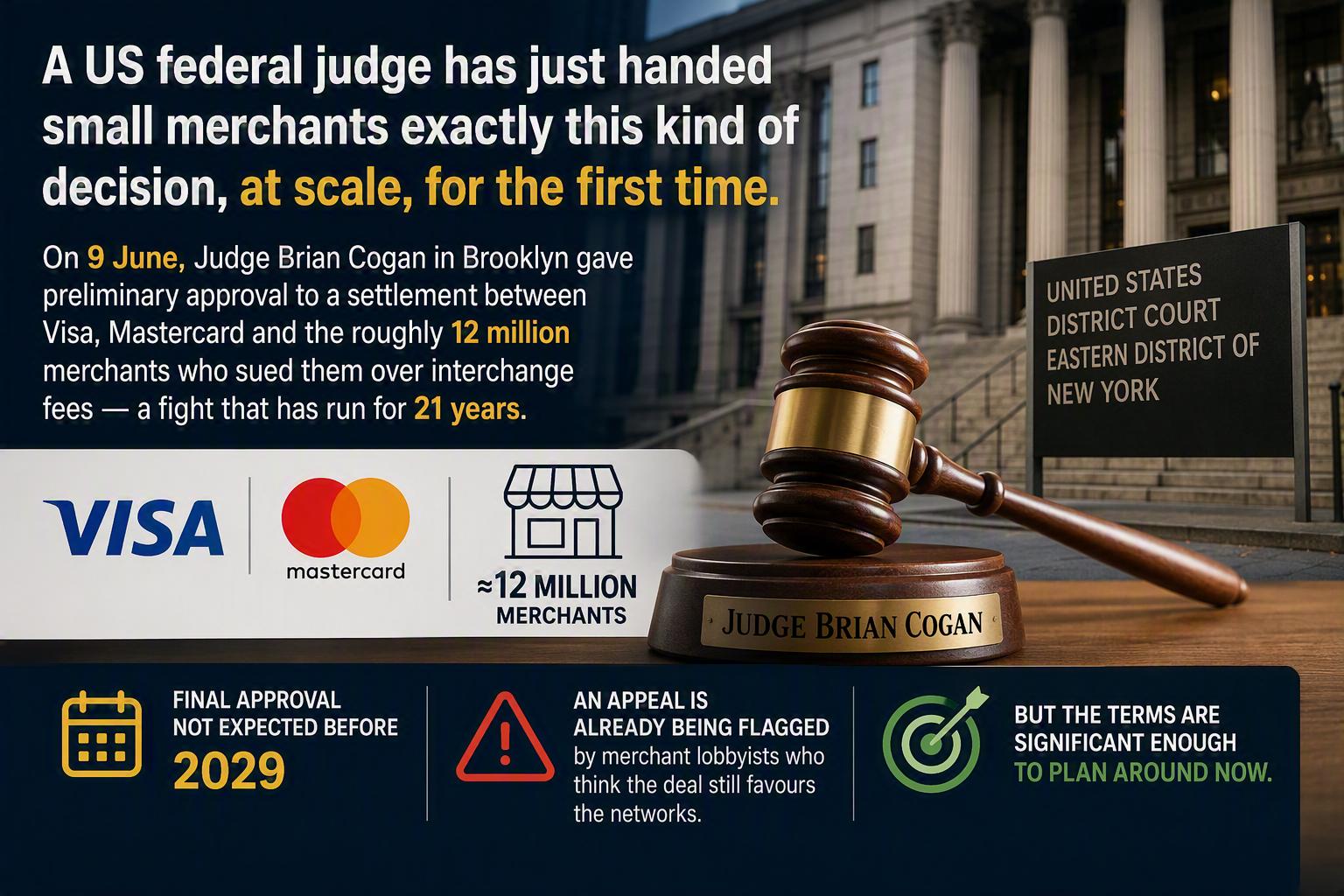
Not long after news of the merchant card fee settlement began circulating, a client who runs a growing trade supply business got in touch with a question that caught my attention: “If merchants are being compensated for historical card fees, how do I know what I’m paying today is fair?” Despite processing significant annual card volume, he couldn’t explain the difference between interchange, scheme fees, and acquirer charges. His finance team could see the monthly bill. They couldn’t see the pricing decisions hidden inside it. A US federal judge has just handed small merchants exactly this kind of decision, at scale, for the first time. On 9 June, Judge Brian Cogan in Brooklyn gave preliminary approval to a settlement between Visa, Mastercard and the roughly 12 million merchants who sued them over interchange fees — a fight that has run for 21 years. Final approval is not expected before 2029, and an appeal is already being flagged by merchant lobbyists who think the deal still favours the networks. But the terms are significant enough to plan around now. The settlement scraps the “honour all cards” rule that has bound US merchants for decades. For the first time, a retailer can accept a customer’s standard consumer Visa while declining their premium travel-rewards card, or reject commercial cards altogether. Interchange on standard consumer credit is capped at 1.25 per cent for eight years; the broader effective rate drops by 10 basis points over five. Merchants also get wider latitude to surcharge. None of this is trivial — merchants paid a weighted average of 2.35 per cent on Visa and Mastercard transactions in 2024, according to the Nilson Report — but the interesting part isn’t the rate. It’s the decision-making the rate now requires. Here is the part the settlement’s architects seem to have half-noticed and then underfunded. Buried in the terms is a line for a “merchant education program about payment acceptance and cost management.” One line, no detail on scope, no indication of who delivers it or to whom. The card networks have effectively conceded that the people now empowered to categorise cards, price surcharges and steer customers toward cheaper payment methods have no particular reason to know how to do any of that. Then they wrote a single clause about it and moved on. I have watched this exact gap play out before, because the UK and EU already ran this experiment. Brussels capped interchange at 0.3 per cent for credit and 0.2 per cent for debit back in 2015, more than a decade before Washington got anywhere near it. If a hard cap were sufficient to close the capability gap, UK merchants would by now be sophisticated readers of their own payment costs. Most aren’t. Acquirer statements remain close to unreadable for a business owner without a finance background; blended pricing still obscures what any given card actually costs to accept; surcharging rules under the UK’s Payment Services Regulations get applied inconsistently or not at all, often out of simple uncertainty about what’s permitted. A rate cap changes what a merchant is owed. It does nothing to change whether they know they’re owed it, or how to collect. That gap sits in an unglamorous place — the layer between the card network and the merchant’s bank account. Merchants aren’t billed by Visa or Mastercard directly; a processor, a PayFac, or increasingly a software platform sits in between, and a headline rate reduction has to survive that intermediary’s own margin before it reaches anyone’s till. US merchants are about to discover what UK merchants already know: the acquirer or PayFac relationship is where savings quietly disappear, and almost nobody renegotiates that relationship because almost nobody has been taught how. This is where Vogue Boost’s founding premise comes from, not the other way round — we built a fintech upskilling company because the pattern kept repeating across every part of financial infrastructure I’d worked in. Regulators and networks fix the plumbing. Nobody teaches the people standing next to the taps how to use them. None of this argues against the settlement, appeal risk and all. Ending “honour all cards” is a genuine transfer of leverage from networks to merchants, and merchants should take it. But leverage unused is not leverage at all, and a merchant who doesn’t know she can now decline a loss-making commercial card is no better off than one operating under the old rule. The three-tier card categorisation this settlement introduces — commercial, premium consumer, standard consumer — is itself a decision layer most small business owners have never had to navigate, and there’s no natural constituency responsible for teaching them. So the question for policymakers on both sides of the Atlantic isn’t whether interchange caps or settlement terms are generous enough. It’s who is accountable for making sure the businesses affected can actually act on them. The FCA, the Payment Systems Regulator and their US counterparts have spent years negotiating the price of the plumbing. It’s time someone was made responsible for the people who have to use it.
Europe is about to let in the stablecoins nobody understands
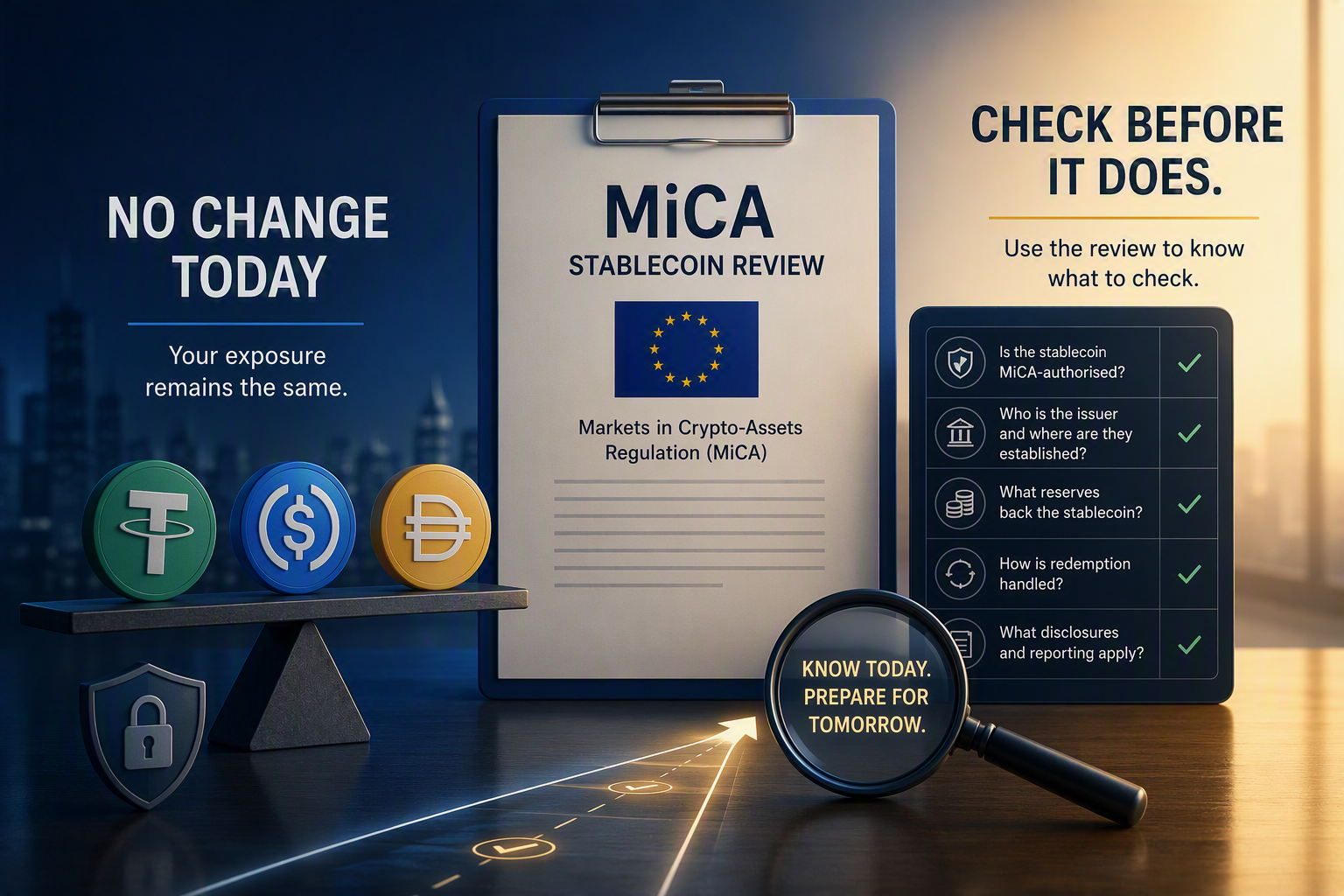
Europe is about to let in the stablecoins nobody understands Tether has never held a MiCA licence. Europe’s largest crypto exchanges list it anyway, routing round the rule rather than through it, because European users keep asking for it and European law has no answer for what happens when they get it. That gap is what the European Commission opened a consultation to close on 20 May, and it is due to report by the end of August. The proposal under discussion would let non-EU stablecoin issuers operate inside the bloc, provided their home regimes are judged equivalent to Europe’s own. It is a sensible fix to a real problem. It is also the wrong problem to be fixing alone. What MiCA never asked The Markets in Crypto-Assets Regulation, when it came into force in 2024, built a reasonably coherent perimeter around issuers, reserves and redemption rights — for firms based in the EU. It said almost nothing about what happens when the reserves, the redemption promise and the legal recourse all sit in Delaware or the Cayman Islands, and the user sits in Frankfurt. The review now under way exists because that omission became untenable once the United States passed its own stablecoin framework, the GENIUS Act, and dollar-backed tokens started moving faster than European law could track them. So the Commission is doing the obvious thing: building an equivalence regime, so a Tether or a Circle can operate in Europe if their home jurisdiction meets EU standards. Patrick Hansen at Circle put the current situation plainly — European users are, in his words, either unprotected or cut off. Fair enough. But notice what the fix targets. It targets the issuer. It says nothing about the person deciding whether to hold, recommend, or process one of these instruments in the first place. The compliance officer who has to decide There is no functional way to explain to a client why a dollar-backed token redeemable in Delaware carries different risk from a euro-denominated one licensed in Paris. That is not a knowledge gap you close with a leaflet. It is a structural one, because the products changed faster than the training did. Multiply that by whatever number of newly admitted, differently domiciled stablecoins come through an equivalence regime once it’s live, and the problem doesn’t shrink. It compounds. A compliance officer at a mid-sized UK bank will soon have to assess counterparty risk across issuers governed by two, three, possibly more overlapping regulatory regimes, each with its own redemption mechanics and its own definition of what “backed” actually means. Nobody has built the training for that. Nobody is planning to. There’s a parallel worth a sentence, no more: this is roughly the same shape of problem HMRC created with Making Tax Digital, where the compliance machinery got upgraded and the humans required to operate it didn’t. Regulators are good at building rails. They are not, on the whole, in the business of teaching people to walk them. Equivalence is not understanding The Commission’s equivalence test — is a foreign regime “as good as” ours — answers an institutional question. It does not answer a human one. A stablecoin issued under an equivalent regime is not therefore a stablecoin your average IFA, or your average retail saver, has any better grasp of. Equivalence tells the regulator the plumbing is sound. It tells the person holding the asset nothing at all. ESMA’s own parallel review of custody and operational resilience, running from July through the first half of 2027, is a tacit admission of this. If the infrastructure needs eighteen months of scrutiny before anyone trusts it, the case for pausing on capability is at least as strong. Yet capability doesn’t appear on the consultation’s list of questions — I’ve read it twice to check. The reckoning None of this is an argument against opening MiCA to non-EU issuers. American money is not going to wait for Brussels to feel ready, and pretending otherwise just pushes European users back into the unlicensed grey market this review is meant to close. But a regulator that spends three years building an equivalence regime for issuers, and zero months building capability for the people who have to apply it, has solved half a problem and called it done. The Commission has until the end of August to decide what the next phase of MiCA looks like. It should ask, alongside every question about reserves and redemption, who in the market is actually equipped to price the risk it’s about to let in — and what it intends to do about the ones who aren’t.
FinTech — 29 July 2026 (UK + US)
HMRC digitised the tax system. It forgot to digitise the taxpayer.
HMRC digitised the tax system. It forgot to digitise the taxpayer. Making Tax Digital’s first deadline lands on 7 August. Most of the people it affects still don’t know it’s coming — and the lesson reaches well beyond tax. On 7 August, roughly 864,000 sole traders and landlords will find out whether Britain’s tax system was built with them in mind. That is the day the first quarterly update under Making Tax Digital for Income Tax falls due — HMRC’s most significant change to self-assessment in a generation, and the first hard deadline of a reform years in the making. On paper, the requirement is modest: a digital summary of income and expenses, filed through approved software, replacing part of the old annual paper trail. Research published by Sage in the weeks before the deadline found that only 37 per cent of those affected could correctly name the date. I recognise this shape. Thirty years spent investigating financial crime, running technology organisations through regulatory upheaval, and building companies at the point where fintech meets the people who actually have to use it, teaches you one lesson above the rest: systems fail not at the point of design, but at the point of use, among the people nobody consulted while building them. Making Tax Digital is not a software rollout gone slightly wrong. It is what happens when an institution digitises its own machinery and calls that the whole job. The evidence is not subtle. Research by IPSE and Sage last year found that only three in ten sole traders had a clear understanding of what MTD actually requires; a third were still keeping records on paper, two-thirds used spreadsheets, and more than half tracked income straight from bank statements. When Xero surveyed the same population as the April mandate took effect, 41 per cent said they were not ready, more than a quarter admitted they were behind schedule and unsure whether they would meet the August deadline, and one in seven had taken no action at all. Lloyds Banking Group’s research, drawn from sole traders already above the £50,000 qualifying threshold — the very group required to comply now — found that 55 per cent still had work to do. HMRC’s logic for the reform is sound as far as it goes. The department estimates that avoidable errors and simple failures to take reasonable care account for up to £9 billion of the tax gap each year — the shortfall between tax owed and tax actually collected — and it believes real-time digital records will close much of it. But the scope only grows from here. The qualifying income threshold falls to £30,000 in April 2027 and to £20,000 in April 2028, pulling roughly 900,000 more people into a regime that the current, better-resourced cohort is still struggling to meet. Each drop reaches further into thinner margins, less accounting support and lower digital confidence — precisely the population least equipped to absorb a compliance shift alone. This is the part policymakers consistently underfund. HMRC built approved-software standards, a penalty framework, and a soft-landing year in which no penalty points apply for late quarterly updates. What it did not build, at anything like the same scale, is a programme to raise the digital and financial capability of the people the reform depends on. Awareness campaigns are not capability. A leaflet explaining a deadline is not the same as teaching someone how to keep digital records, read what their software is telling them, or trust a number they did not calculate by hand. Britain treats financial and digital capability as a private responsibility, something individuals should already have or acquire in their own time, even as it builds public infrastructure that assumes they do. I see the same failure across every domain where financial infrastructure goes digital, from open banking to the early architecture of digital money: the technical build gets funded, tested and delivered on schedule, while the capability to use it safely is left to the market, or to chance. That gap is the subject of the book I am completing on how states are choosing, often by default rather than design, who controls the movement of money and who is left to keep up. Making Tax Digital is a small, domestic, unusually well-documented version of that same choice. Britain has decided, again, that digitisation and capability-building can proceed on separate timetables. They cannot. None of this argues for slowing MTD down. Quarterly digital records are a reasonable ask, and the tax gap they target is real money that other taxpayers effectively subsidise. But every threshold drop between now and 2028 will bring in people with less capacity to cope than the cohort filing this August, and government cannot keep treating that as someone else’s problem to solve after the fact. If HMRC and the Treasury are serious about a digital tax system, they need to fund capability with the same seriousness they fund compliance software — measured, resourced and owned, not left to accountants, banks and fintech firms to patch together after the deadlines have already landed. The 7 August deadline will pass quietly for most of Westminster. For most of the people it actually applies to, it will not.
Daily FinTech Sweep & Rank — 24 July 2026 (UK & US)
Daily FinTech Sweep & Rank — 24 July 2026 (UK + US) 1. US replaces its 10% global tariff with permanent Section 301 duties of 10–12.5% on UK and EU goods What happened: The US Section 122 tariff (a temporary 10% flat rate, capped by statute at 150 days) expired at midnight ET on 23–24 July. The USTR immediately imposed replacement Section 301 duties of 10–12.5% on roughly 60 trading partners, including the UK and EU, effective 12:01am ET Friday 24 July. Sixty trading partners, including all of America’s most important ones, will face tariffs of 10% to 12.5%, according to a US Trade Representative fact sheet. Unlike Section 122, Section 301 tariffs carry no expiry date and no statutory rate cap, so this is not a temporary measure — it is the new baseline. UK steel and aluminium remain separately covered under the existing 25% Section 232 arrangement agreed under the UK–US Economic Prosperity Deal. ZonosTariffstool Why it matters to operators: Any UK or US SMB importing from, or exporting to, the other market faces an immediate landed-cost increase on goods cleared from today. Postal/de minimis thresholds have also shifted — for UK e-commerce sellers shipping direct to US consumers, the duty-prepayment threshold on postal shipments rises from $800 to $2,500 from today, changing checkout economics for small parcels. So what: Reclassify affected SKUs against current HTS codes today — no grandfathering applies to shipments arriving after 24 July regardless of when they were dispatched. Model the 10–12.5% margin hit into pricing and cash-flow forecasts now, and check eligibility for duty drawback on any returned goods, which can recover 80–95% of duties paid. 2. HM Treasury opens consultation on the biggest UK payments-regulation overhaul in a decade What happened: HM Treasury published a consultation on 14 July 2026 proposing a major overhaul of UK payments regulation, shifting to an FCA-led model, accommodating agentic AI-tokenised payments and reforming the Open Banking framework. The reforms would move many detailed requirements from the Payment Services Regulations and Electronic Money Regulations into the FCA Handbook, and would create a single framework covering both conventional and tokenised payments. The consultation closes 6 October 2026. FCAFCA Why it matters to operators: This reshapes the rulebook governing every payment institution, e-money issuer and Open Banking provider an SMB relies on for payment acceptance, payroll, and treasury services — with knock-on effects for pricing, integration timelines and provider stability as firms adjust to a new supervisory regime. So what: SMBs with material exposure to payment providers, embedded finance partners or Open Banking tooling should flag the consultation to their finance/ops leads now and consider a response (directly or via a trade body) before 6 October — early positioning matters given the scale of the proposed restructuring. 3. BNPL is now a regulated credit product in the UK — enforcement live since 15 July What happened: From 15 July 2026, Buy Now Pay Later fell under FCA supervision as a fully regulated consumer credit product, with lenders required to operate within the same governance and risk-management frameworks used for traditional lending. Mandatory affordability checks now apply to every BNPL transaction, users gain access to the Financial Ombudsman Service and Section 75 protections for new agreements, and the FCA has banned backdated interest. Reed SmithYahoo Finance Why it matters to operators: Retail and e-commerce SMBs offering BNPL at checkout (Klarna, Clearpay, PayPal Pay-in-3 and similar) now sit downstream of a regulated credit product rather than a simple payment method — checkout friction, refund/dispute handling (Section 75 exposure) and merchant agreements are all affected. So what: Review merchant agreements with BNPL providers for updated affordability-check flows and dispute-liability terms; confirm the provider held valid Temporary Permissions Regime registration or full FCA authorisation, since operating with an unauthorised BNPL partner is a live compliance risk for the merchant, not just the lender. Also on the radar: Stripe/Advent reportedly bid ~$53bn for PayPal — unconfirmed per Reuters sourcing, but a deal would reshape acquiring/processing relationships across both markets. 46 US states settle with Block (Cash App) for $45m over fraud-protection misrepresentation, with a separate CFPB consumer-redress fund of $75–120m — relevant for any SMB holding working capital in payment-app balances rather than a bank account. PSR APP fraud evaluation and roadmap (published 1 July): reimbursement rules cut Faster Payments fraud losses by an estimated £73m/year; a formal consultation on scope and consistency is now expected in December 2026. UK regulators begin overseeing Critical Third Parties (cloud providers) from 10 July — relevant for SMBs assessing vendor/platform concentration risk in their supply chain. CSI acquires Qolo (US card-issuing/multi-rail infrastructure vendor) — a sign of continued consolidation among the API-based platforms many SMB-facing fintechs are built on.
Buy now, pay later grows up. Its customers still need to.
Buy now, pay later grows up. Its customers still need to. On Wednesday, buy now, pay later finally comes under regulation. I’ve argued for years that it should. And I’m still worried. Here’s why. The first time I watched a young woman split a £48 pair of trainers into four payments, she didn’t think she was borrowing. She was shopping “more sensibly,” she told me. That sentence is the whole story. From this week, lenders must be authorised, run affordability checks on every purchase, and answer to the Ombudsman when things go wrong. Overdue and welcome — a £13bn market used by one in five UK adults should never have sat outside the rules this long. But regulation governs how a product is sold. It doesn’t touch whether the person buying it understands what they’ve taken on. And look at who that person usually is. Roughly two-thirds of frequent BNPL users in Britain are women, most in their late twenties and thirties. Not reckless — default rates sit near 2%, versus around 10% on credit cards. Just financially stretched, using the one flexible, interest-free credit that ever felt built for them. Fair4All Finance estimates tougher checks could exclude 10–30% of current users. Some shouldn’t have been lent to. But many will carry a very real need for credit through a darker door instead. Demand doesn’t disappear when you regulate supply. It relocates — usually somewhere with less light on it. We’ve built a regime that disciplines the lender. We’ve built nothing to equip the borrower. That’s the gap. And it has no regulator, no deadline, and — so far — no champion. Wednesday makes BNPL safer to sell. The harder work is making people abler to buy. Who’s picking that up? #FinTech #FinancialInclusion #BNPL #FinancialLiteracy
The Asymmetric Prep Window: A 90-Day Operator Brief on UK Financial Regulation
The Asymmetric Prep Window: A 90-Day Operator Brief on UK Financial Regulation The second half of 2026 will not look like the first. Five UK commencements, one underlying thesis, and the narrow window in which pre-compliance is structurally cheaper than retrofit. Today the Bank of England’s Bank Rate sat at 3.75%, and that figure quietly locked in the statutory interest rate on every commercial invoice that will become overdue between tomorrow and 31 December. I addressed the mechanic of that lock-in at length in today’s Newsletter. I open with it here because it illustrates a wider point about how UK financial regulation actually moves: not in big announcements, but in commencements — quiet effective dates that change the operating environment before most operators notice. Tomorrow is 1 July. H1 closes today. The second half of 2026 brings five UK commencements with asymmetric implications for SMB operators. Some are narrow and technical. Some are universal. None are optional. All of them are easier to absorb in advance than under deadline pressure, and the window in which that is true is closing. This is the operator’s brief for the next ninety days. 13 July — Section 1(1) of FSMA 2023 takes a further bite. The Commencement No. 14 Regulations bring into force the revocation of EU Regulation 236/2012 on short selling and credit default swaps, together with the Financial Services and Markets Act 2000 (Short Selling) Regulations 2012. The substantive implications sit primarily with asset managers and prudential firms. For most SMB operators the relevance is indirect: it is part of the ongoing pattern of assimilated EU financial law being repealed and re-laid as UK rules. The pattern itself is the point. By the time the regime is fully UK-anchored, the firms that have been tracking each commencement will have a coherent map of the new architecture, and the firms that have not will be reading it cold. Mid-July — Deferred Payment Credit enters the FCA’s regulatory perimeter. Until now, a defined subset of buy-now-pay-later products — interest-free loans repayable in twelve or fewer instalments over twelve months — have sat outside the consumer credit regime by virtue of an exemption in Article 60F of the Regulated Activities Order. From July, that exemption falls away. Any SMB that provides deferred payment credit directly, or brokes it via a third party, will need to be authorised. For retail and e-commerce SMBs that offer pay-in-three or pay-in-four at checkout, this is the most direct H2 change of all. The operator move is to map every customer-facing credit instrument against the new regulated activity definition this month, before the authorisation queue builds. 1 September — Non-Financial Misconduct rules extend to all FCA-regulated firms. From this date, bullying, harassment and violence committed against any colleague in connection with their work fall within the Code of Conduct, regardless of whether the conduct relates to a regulated function. For FCA-authorised firms — including FinTech start-ups, payments firms, and any SMB operating under a permission — this is a material expansion of the conduct regime, and the documentation, training and escalation infrastructure will need to be in place on the day, not after the first incident. Operators who do not yet hold an FCA permission should not skim past this one; the rule sets a baseline for how conduct cases will be tested across the sector, and HR policies that fall short of it will read increasingly amateurish. 30 September — The cryptoasset authorisation gateway opens for applications. Firms that intend to provide cryptoasset services in the UK from October 2027 — when the full regime goes live — must be authorised by the FCA. Applications can be submitted from 30 September. The FCA has been clear that firms which delay risk being forced into contractual run-off, or out of the UK market, if their application is not approved in time. For SMBs whose business model touches custody, trading platforms, staking, or stablecoin issuance, the pre-application infrastructure needs to be in place by August. The Pre-Application Support Service is currently free and underused; that asymmetry will not last. Late 2026 or early 2027 — The late payment reforms confirmed on 24 March take effect. Statutory interest becomes mandatory rather than optional. A 60-day ceiling applies to B2B payment terms where a larger purchaser contracts with a smaller supplier, falling to 45 days after five years. A 30-day invoice verification deadline takes effect. The Small Business Commissioner gains investigatory and fining powers, with penalties potentially equal to a percentage of turnover. The legislation requires primary and secondary instruments before commencement; the first measures are expected to land late this year or in Q1 2027. This is the universal SMB item on the list. There is no operator it does not touch. That is the calendar. Now the thesis. Regulatory cycles have a structural feature operators routinely underestimate: the period between confirmation and commencement is the cheapest window in which to comply. A late payment regime confirmed in March and effective in early 2027 gives operators eight to ten months in which contractual templates, billing systems, and supplier-facing terms can be updated calmly, against the existing baseline, with no enforcement pressure. The same updates carried out two weeks after commencement are made under deadline, against a regulator looking for early examples, often by external counsel charging premium rates. The cost differential is not marginal. It is multiples. The same logic applies to every item above. The DPC regime confirmed in July is easier to map in June than in August. The NFM rules confirmed for September are easier to embed in HR processes in July than on 2 September. The cryptoasset authorisation gateway is easier to navigate via the Pre-Application Support Service in August than via formal application after October. This is what I mean by the asymmetric prep window. The cost of compliance is not the cost of the rule. It is the cost of when the rule is absorbed. Operators who treat regulatory dates as targets — to
What you’re known for is what you’re priced as
The terms on which a British SMB refinances in 2028 are being set today, not by the macroeconomic outlook but by signals the business sent three years ago. The same is true of its supplier pricing, its hiring channels and the access its operations team is granted to strategic conversations. Markets categorise businesses on the cheapest signal available, and the categories — once set — are slow to move. The cost of being boxed by an outdated reputation is one of the least examined drags on SMB performance in this country. The mechanism is not malicious. It is cognitive economy. Customers, suppliers, lenders, recruiters and regulators each operate with limited attention and assign categories on the first reliable signal they receive. If a business’s earliest invoices were paid late, it is now the late-paying buyer. If its first product was the cheap option, it is now the cheap brand. If its finance team has historically deferred to the chief executive, it is now operational rather than strategic. The category is built from one signal and reinforced by every subsequent interaction that does not contradict it. Forming a category takes one signal. Dissolving it takes a dozen. The market rarely pays attention long enough to register the dozen. The cost compounds in ways that seldom appear on a profit-and-loss statement but consistently appear in working-capital terms, supplier pricing and contract negotiations. An operator who tries to refinance finds her terms reflect three-year-old behaviour. A buyer discovers he is priced above larger competitors not because the volume justifies it but because the relationship was set in an earlier era. A finance team that has spent five years presenting numbers without challenging them remains excluded from the conversations where the numbers actually get used. None of this needs to be accurate to be expensive. It only needs to be unexamined. The instinct, when an operator notices the box, is to argue out of it: explain the misperception, send the corrective email, post the corrective view. This rarely works, and the reason is structural. Categories are not arguments; they are habits. A supplier’s pricing system, a lender’s risk model, a recruiter’s CRM tags and a board’s meeting-invite list are infrastructure, not opinion. They do not change in response to a paragraph. They change when the underlying signal changes, and only when that signal is delivered with enough frequency that the system has to rewrite the entry. The box responds to evidence, not rhetoric, and to evidence sustained over time. This is where the financial and digital literacy gap inside the British workforce stops being a developmental issue and becomes a positioning one. The government has set a 2028 horizon for implementation; the market has set none. A team that cannot read a cash-flow statement will be categorised as operational regardless of its ambitions. A founder who delegates the numbers will be categorised as visionary-but-unreliable regardless of the strategy deck. A business whose managers cannot articulate working-capital dynamics to a lender will be categorised as a risk regardless of the underlying credit quality. The category follows the visible capability, and the visible capability follows the actual one. Closing the gap is not about producing certificates. It is about giving the business a different signal to send, and ensuring the signal reaches the parties who hold the category. Forensic work makes this pattern legible in a way that ordinary commercial review does not. When financial misconduct, intellectual property loss or contract failure reaches litigation, the post-mortem almost always reveals the same architecture: a team or individual was categorised early, treated accordingly, and the resulting information asymmetry became the vulnerability the loss flowed through. The founder who was not “a finance person” did not see the fraud. The operator who was “just delivery” was not consulted on the contract. The director who deferred on the numbers signed what she had not read. The category preceded the catastrophe. The mirror image of this pattern is equally consequential. The founder treated as the financial brain of the business — the one person the team will not second-guess — becomes the single point of failure. No one queries the figures. No one flags the unusual transaction. The category that elevates produces the same access asymmetry as the category that diminishes, and the loss flows through it just as readily. The implication for the British SMB operator is uncomfortable. The box others have drawn around the business is not their problem to fix. It is the operator’s. The only durable way to reshape it is to change what the business and its team can demonstrably do — visibly, repeatedly, in front of the parties who hold the category. Make the financial literacy of the operations team something a lender registers in the first ten minutes of a call. Make the digital capability of the back office something a supplier notices the moment they integrate. Make the strategic articulation of the numbers something a board member feels in the first paper they read. None of this is persuasion. All of it is signal, delivered into the systems that hold the category and given enough repetitions to overwrite the entry. The 2028 deadline gives operators a fixed horizon to act inside. The market gives them no such grace. The categories that will price refinancing, contracts and hires in 2028 are being drawn now. The question is not whether the business has been boxed. It has. The question is which signal it intends to send next, and to whom, that will not fit inside the box it currently occupies.