


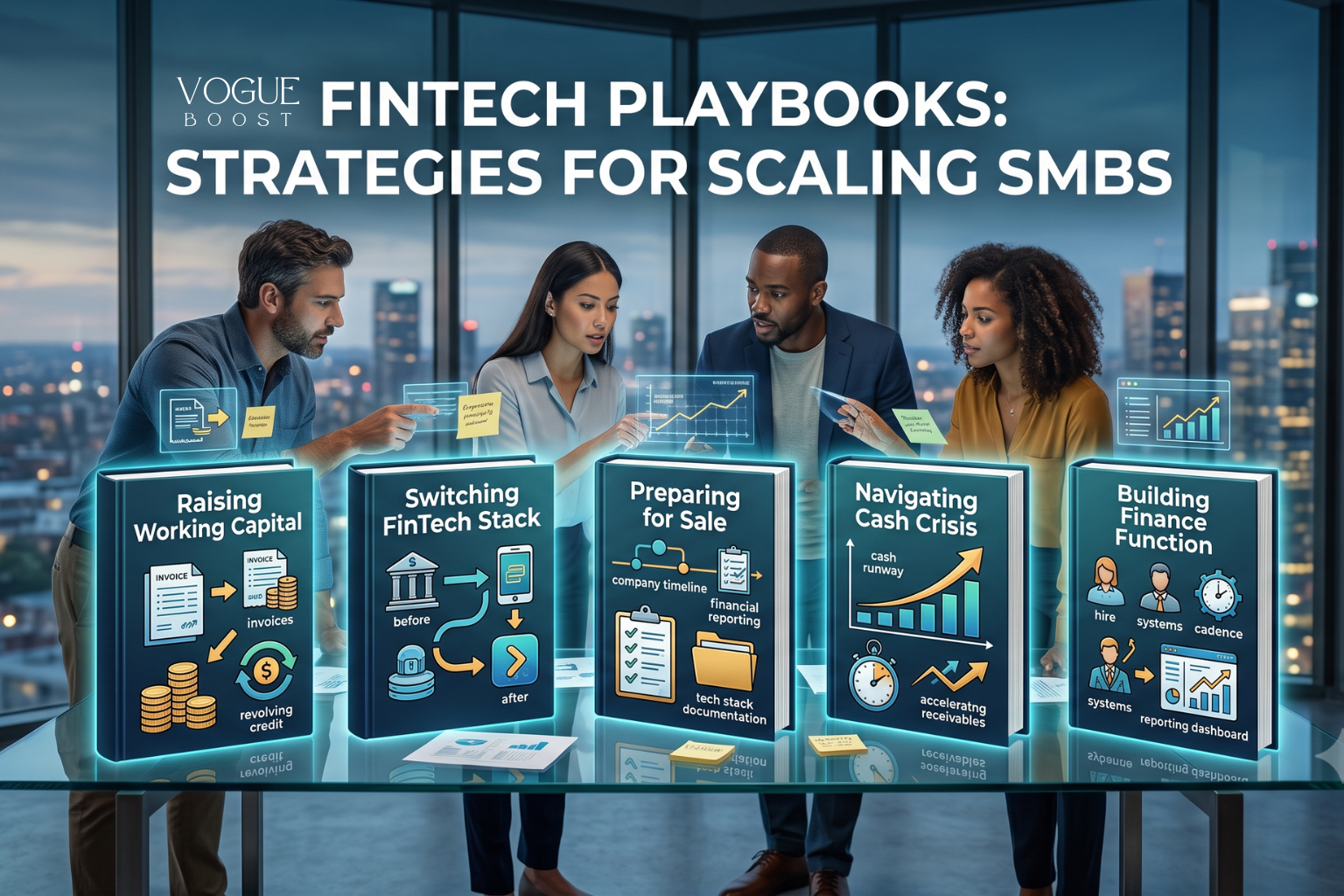



Switching FinTech Stack
Switching FinTech Stack · PLAYBOOK · UK & US
One stack, safely retired.
A new one, live in eight weeks.
Switching a bank, a payments provider, an accounting platform, or an invoicing tool rarely fails because of the new vendor. It fails on sequencing — a mandate not re-established, a reconciliation broken mid-cycle, an old account closed a week too early. This Playbook takes you from “we’re switching” to a fully migrated stack — every payment relationship intact through cutover, the old provider properly closed out, a rollback plan built the whole way through — across eight sequenced weeks. UK and US mechanics covered inline, flagged at the point where they diverge.
Download
Playbook: Switching FinTech Stack
Is this Playbook for you
Five questions, answered honestly, tell you whether this is your Playbook:
- Are you actively planning, or already partway through, a switch of your business bank account, payments provider, accounting platform, or invoicing tool?
- Do you know, right now, every recurring payment — inbound and outbound — that runs through the layer you're switching?
- Has your current provider given you a deadline shorter than eight weeks?
- Does the layer you're switching touch payroll, directly or indirectly?
- Is your business currently in a cash crisis, rather than switching on your own terms?
If the last answer is yes, this isn’t your Playbook — see Navigating a Cash Crisis instead. Everything else here assumes you have weeks to sequence the move, not days.
THE FIVE-PART STRUCTURE
Every Playbook follows the same five-part structure across eight weeks.
1
Part: Scope
What it does: The outcome you'll ship in eight weeks — named, framed, defensible against scope creep
2
Part: Diagnostic + entry
What it does: Where you are now against the problem, and the framing that anchors the plan
3
Part: Main chapters
What it does: The sequenced implementation work — where decisions and moves get made
4
Part: Tooling
What it does: The operational assets deployed — spreadsheets, templates, checklists
5
Part: Synthesis + exit
What it does: Locking in the outcome, the ongoing rhythm, and what comes after
What's inside
What’s inside — the six chapters
Chapter | Title | What it covers |
1 | Why Stacks Get Switched, and the Vendor Menu Read Straight | Forced versus chosen triggers, and the UK and US vendor menu across bank, payments, accounting, and invoicing |
2 | Mapping Your Dependency Chain | Building a single-page map of what depends on the layer you’re switching, with payroll flagged as the highest-consequence dependency |
3 | The Payment Mandate Inventory | Every inbound and outbound mandate, inventoried before cutover — and the CASS-versus-manual-ACH divergence that changes the whole chapter |
4 | Building the Parallel-Run and Data Migration Plan | How long to run old and new side by side, what to migrate versus archive, and guarding against bank-detail-change fraud |
5 | Cutover Week: Running the Switch Live | Choosing the date, the cutover sequence, the first 48 hours, and the first post-cutover reconciliation close |
6 | Closing Out the Old Stack, and the Rollback Plan You Hopefully Didn’t Need | Off-boarding, records retention, and retiring the rollback plan |
What’s inside — the tooling
Tool | What it does |
Stack Dependency Map | Maps every system, mandate, and integration touching the switching layer against the four-layer hierarchy |
Payment Mandate Inventory Tracker | Tracks every inbound and outbound mandate to confirmed-complete status before cutover |
Vendor Evaluation Matrix | Scores candidate providers on cost, fit, integration, and off-boarding terms — not headline pricing alone |
Parallel-Run Reconciliation Tracker | Weekly cross-check between old and new systems through the parallel-run window |
Cutover Day Runbook | Hour-by-hour, dependency-ordered checklist for the live switch |
Rollback Plan Template | Named trigger conditions and reversal steps, built before cutover |
Off-Boarding and Closure Checklist | Data export, final invoice reconciliation, formal closure, records retention |
Examples
Worked examples
Switching FinTech Stack
- Two operators, two markets, one Playbook.
-
UK example :
Thornbury & Co, the UK B2B marketing agency, switches its business bank account after its high-street relationship-manager model stops fitting a growing multi-currency supplier book — checks the FSCS-versus-safeguarding question before signing, confirms CASS eligibility, and keeps the old account dormant for a full quarter before formal closure. -
US example :
Meridian Fulfillment, the US e-commerce fulfilment business, migrates from a smaller accounting platform to NetSuite as order volume outgrows what the old platform's reporting can handle — its Chapter 2 dependency map catches a warehouse-management integration and a multi-state sales-tax add-on nobody had previously thought of as "accounting-adjacent." -
Note:
Both run through the same six chapters. Neither cuts over without a rollback plan.
Where this Playbook fits
Adjacent product | The connection |
CAP-017 — Tool-Stack Integration Capsule (in scoping) | Shorter, single-capability version of this Playbook’s dependency-mapping material, for an additive tool decision rather than a full switch |
CAP-005 — Open Banking & Data Layer Capsule (in scoping) | Extends Chapter 1’s vendor menu on the Open Banking and bank-connectivity layer specifically |
CAP-009 — Reconciliation Capsule (in scoping) | Extends Chapter 4’s parallel-run cross-checks for reconciliation gaps beyond a single migration |
CAP-013 — Regulatory & Compliance Rhythm Capsule (in scoping) | For a switch driven by a compliance obligation rather than a commercial choice |
Signal Room — UK/US payments infrastructure | Ongoing market context on the bank, payments, and Open Banking landscape this Playbook’s Chapter 1 menu draws from |
Private Strategic Access | For multi-entity, cross-border, or adversarial off-boarding situations this Playbook’s general chapters don’t resolve |
pricIng
Playbooks:
Subscription. No per-Playbook purchase.
Monthly or annual.
Cancel anytime.
Subscription:
Playbook subscription includes access to every published Playbook plus every Playbook as it launches. Complete a Playbook and stay subscribed for the next one, or cancel when the problem is shipped.
Read
Or read the SERIES piece on DSO first — the free investigation runs alongside this Playbook.
Team subscriptions and enterprise access: contact access@vogueboost.com
Related
playbooks
— The full Playbook catalogue and the subscription this page’s CTA leads to
Capsules
— CAP-017 Tool-Stack Integration and CAP-005 Open Banking — the shorter, single-capability versions of the ground this Playbook covers in depth (both in scoping).
Series
— Series — The DSO piece — free, investigative, and the natural on-ramp for a reader not yet ready to subscribe.
Signal Rooms
— Ongoing UK/US payments infrastructure context for after the migration closes.
Private Strategic Access
— For switching situations this Playbook’s general guidance doesn’t resolve.
READ ALSO
- All
- Back
- SIG-A
- SIG-R
- Back