




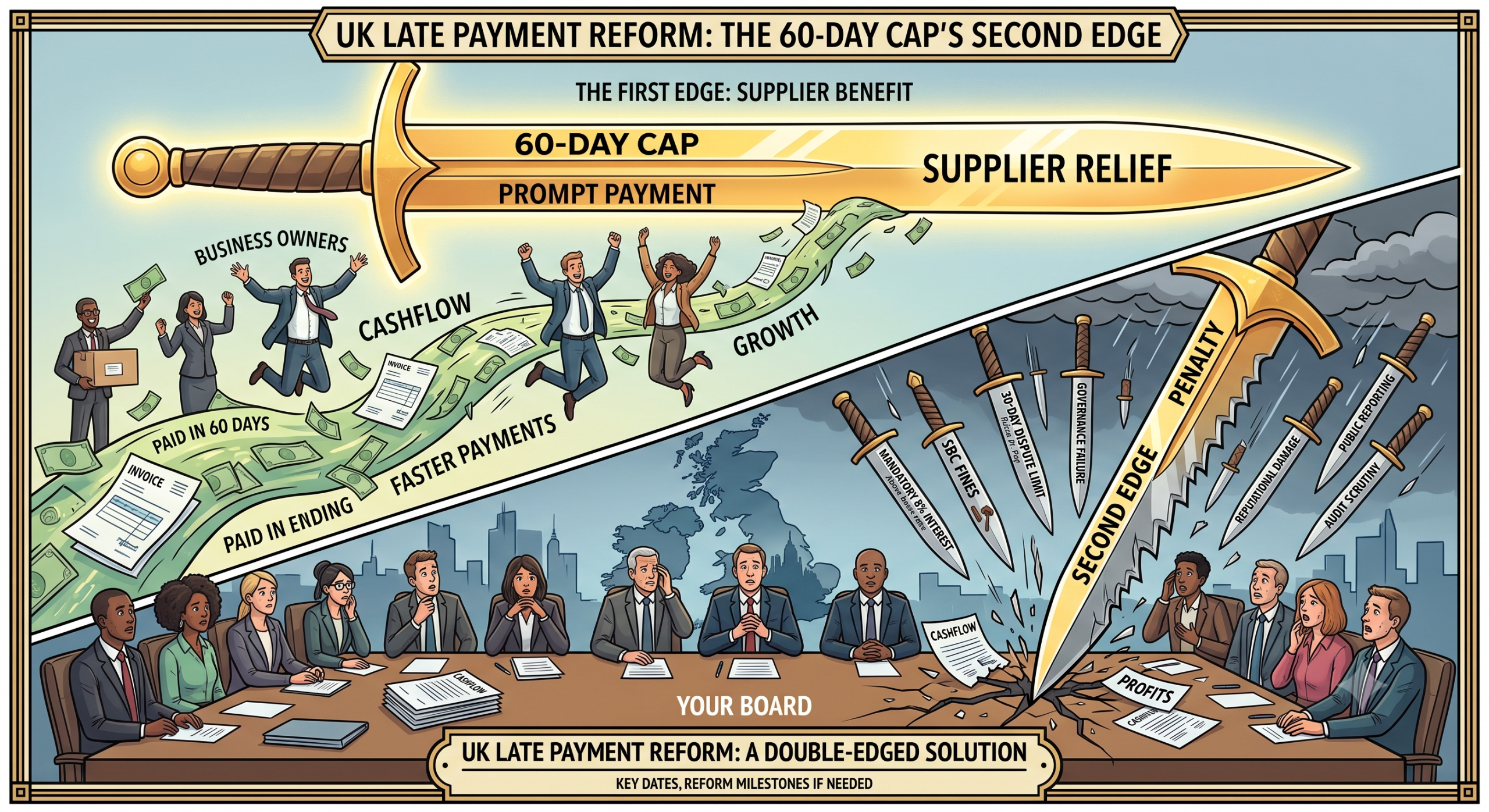
The 60-day cap: a working-capital reset — and a ceiling worth beating
The government confirmed its late-payment reforms on 24 March 2026, now carried by the Commercial Payments Bill before the Lords. The analyst read, and the founder’s reaction.
The analyst briefing
The read. The government’s 24 March response is being filed by most firms under “payments compliance.” That is the wrong drawer. The confirmed package — a non-waivable 60-day ceiling, mandatory statutory interest at base + 8%, a fixed dispute window, and board-level reporting of payment performance — reprices the cost of holding a supplier’s cash and compresses the tenor of trade receivables across the economy. For a finance lead, this is a working-capital event first and a compliance task second.
What actually changes structurally.
The payables buffer shrinks. Stretching suppliers to 90 or 120 days has been a free, uncommitted working-capital line for large payers. The cap removes it, and the non-waivable interest prices whatever remains. Days payable outstanding converges towards 60, and the cash that convergence releases upstream has to come from somewhere on the payer’s own balance sheet.
Receivables shorten — and so does the paper built on them. A hard 60-day ceiling shortens the tenor of the invoices sitting underneath invoice discounting, factoring, supply-chain finance and receivables securitisation. Providers of working-capital finance will reprice and restructure around shorter, more uniform receivables. If you fund growth against your receivables, expect both the terms and the availability to move.
Payment performance becomes a board number. Once payment data sits in the audited Directors’ Report and carries director-level exposure for misreporting, DSO and DPO stop being treasury metrics and become governance metrics. Persistent late payment carries a reputational and disclosure cost now, not merely a relationship one.
The forward read. Implementation lands no earlier than 2027, carried by the Commercial Payments Bill now before the Lords. The 45-day ceiling has been shelved, not killed — the direction of travel is shorter, and the government has reserved the right to return to it. Plan to the trajectory, not the first milestone.
The position. This is a cash event before it is a legal one, and it cuts both ways: a supplier’s DSO structurally improves as enforceable interest bites, while a payer’s DPO compresses towards 60 and the old buffer disappears. Quantify both directions now. The firms treating this as a Q4-2026 cash model will absorb it; the firms treating it as a 2027 legal update will meet the cash gap the hard way.
The founder’s reaction
The briefing above is the neutral read. Here is where I part company with it — not on the analysis, but on the number.
I welcome the reform. I don’t accept 60 days.
Confirming a maximum after years of drift is real progress, and the enforceable interest and reporting duties give it teeth. But a maximum is not a standard, and too many finance leaders are about to read “we pay inside 60 days” as a pass mark. It isn’t. It’s the bare minimum the law will now tolerate.
Sixty days is a starting position — the government said so. Ministers chose 60 as a cautious opening, not a destination, and reserved the right to take it to 45. Read that plainly: the state already regards 60 as too slow and expects to tighten it. If the regulator sees 60 as a way-station, no operator should be treating it as an achievement.
The real risk is that the ceiling becomes the floor. The government’s own response flagged it — firms currently paying faster may drift up towards 60 to sit safely under the cap and avoid penalty exposure. That is the perverse outcome: a reform meant to speed payment up quietly slowing it down for the businesses that were already paying well. I would rather this reform dragged my worst supplier terms upward than watch it pull my best ones down towards the legal limit.
So here is the standard I would actually hold. Pay your suppliers in 30 days as a matter of operating discipline, not compliance. It is not charity — it buys priority, loyalty and better pricing from the people you depend on, and it is the cheapest goodwill a growing business can generate. Then chase your own receivables to a sub-45 norm, and treat any customer sitting at the full 60 as a cash-flow risk to manage, not a term to accept. Your DSO target should embarrass the legislation, not match it.
The wider point. Legislation sets the floor of acceptable behaviour. It does not set your standard — you do. The businesses that come out of this ahead will not be the ones that scraped under 60. They will be the ones paying and being paid faster than the law requires, treating “we’re compliant” as the least interesting thing they can say about their cash.
Sixty days is what the state will now permit. It is not what a well-run business should tolerate — from itself, or from anyone it invoices.