

Real‑Time Payments: A Complete Primer RTP, SEPA Instant, PIX & the New Logic of Instant Treasury (Vogue Boost Long‑Form, Narrative‑Driven Edition — Your Signature Style) The Shift No Operator Can Ignore Here’s the quiet truth shaping modern money movement: real‑time payments aren’t a feature anymore—they’re becoming the financial operating system beneath global commerce. In 2026, more than 80 countries now run domestic real‑time rails that settle funds in seconds, not days. For operators, this isn’t about speed. It’s about control—control over liquidity, control over cash timing, control over supplier obligations, payroll precision, and treasury posture. [ftc.gov] When money moves instantly, everything upstream and downstream reorganizes. This primer takes you inside the three rails that matter most—RTP (US), SEPA Instant (EU), and PIX (Brazil)—and the new treasury logic every founder, CFO, and operator must internalize. The Core Concept: What “Real‑Time” Really Means Across geographies, a true real‑time payment system has three non‑negotiable characteristics: Instant clearing—payment validated in seconds Immediate settlement—no pending, no batching Always‑on availability—24/7/365, including weekends and holidays This distinguishes real‑time rails from faster‑than‑ACH systems. A same‑day ACH payment isn’t “instant.” Real‑time rails confirm and settle in the same breath. [ftc.gov] RTP (United States): Liquidity at the Speed of Thought The RTP® network, operated by The Clearing House, is the U.S.’s most mature real‑time system. It’s built for scale and reliability—zero scheduled downtime, instant settlement, and transaction limits up to $10 million. [glenbrook.com] Since 2017, RTP has processed over $1 trillion, with participation now exceeding 1,130 financial institutions. [glenbrook.com] Why RTP Matters to Operators RTP is fundamentally a treasury tool: Precise payment timing Immediate confirmation Rich ISO 20022 data for reconciliation Predictable supplier and payroll disbursements This is the first system in the U.S. where a business can say:“Money leaves when I want it to leave. Money arrives when I need it.” That is liquidity management as a competitive advantage. [thepaypers.com] SEPA Instant (Europe): Pan‑European Instant Liquidity SEPA Instant Credit Transfer (SCT Inst) delivers real‑time payments across the Eurozone with a limit of €100,000 per transfer, settled in seconds. [mastercard.com] This is one of the rare cases where a region has aligned the incentives, regulations, and technical standards to support a single, interoperable, continent‑spanning instant rail. Why SEPA Instant Matters This is instant treasury across borders: Cross‑market liquidity consolidation Supplier payments anywhere in the Eurozone Uniform infrastructure, uniform rules For any business with multi‑country operations, SEPA Instant effectively compresses Europe into one liquidity zone, in real time. PIX (Brazil): Mass‑Market Instant Payments at Planetary Scale Launched in 2020, PIX is one of the fastest‑adopted real‑time payment systems in history. It has fundamentally reconfigured Brazil’s financial landscape. PIX processed tens of billions of instant transactions by 2024 and continues accelerating. [imali.app] Why PIX Matters PIX isn’t just a payment rail—it’s a behavioral shift: Near‑universal adoption QR‑based payments everywhere Instant merchant settlement Mandatory participation for major institutions PIX shows what happens when instant payments become a default, not an option:cash usage collapses, card fees come under pressure, and small businesses gain real‑time cashflow superpowers. How Real‑Time Payment Systems Actually Work Despite geographic differences, the workflow is nearly identical across RTP, SEPA Instant, PIX, FedNow, UPI, and others: Initiation – User triggers payment via bank, app, API Authorization – Funds, identity, fraud checks Network transmission – Payment routed instantly Clearing & settlement – Final within seconds Confirmation – Sender and receiver notified immediately This unified pattern explains why instant payments scale so effectively across borders. [mastercard.com] Instant Treasury: The Operator’s Advantage Real‑time payments don’t merely speed up transactions—they rewrite treasury fundamentals. 1. Liquidity Becomes Continuous With real‑time settlement: Cash concentration becomes dynamic Treasury no longer waits for bank hours Businesses can disburse funds at the last responsible moment This moves treasury from “managing float” to “orchestrating liquidity.” [thepaypers.com] 2. Real‑Time Receivables Transform Working Capital Immediate settlement means: Faster order fulfillment Reduced Days Sales Outstanding (DSO) Precise short‑term forecasting PIX and SEPA Instant have already demonstrated materially improved cash cycles for SMEs. [mastercard.com] 3. Automation Through Data RTP and SEPA Instant use ISO 20022, enabling: Automated reconciliation Clean audit trails Lower errors Rich metadata for treasury analytics RTP highlights real‑time reconciliation as a core feature. [glenbrook.com] 4. Treasury Must Now Operate “Always On” Instant rails require: 24/7 fraud monitoring Automated exception handling Systems that react in real time Legacy treasury processes—built for banking hours—don’t survive in this environment. The shift is already underway. [imali.app] A Comparative Snapshot System Limit Coverage Key Advantage RTP (US) Up to $10M [glenbrook.com] U.S. High‑value treasury payments SEPA Instant €100,000 [mastercard.com] Eurozone Pan‑EU real‑time liquidity PIX Varies Brazil Universal adoption + QR commerce The Operator’s Takeaway Real‑time payments aren’t speeding anything up—they’re compressing the financial world into a continuous system. RTP, SEPA Instant, and PIX each illustrate a different dimension of this shift: RTP shows instant liquidity at enterprise scale. SEPA Instant shows cross‑border interoperability in a unified region. PIX shows mass‑market instant adoption transforming a whole economy. If card payments digitized commerce, real‑time payments are now digitizing cashflow itself. This is the real unlock:Instant payments collapse the distance between decision and outcome.That’s the new operating advantage for the next generation of SMBs, platforms, and fintech infrastructure builders.
Agentic Commerce 101 for Beginners
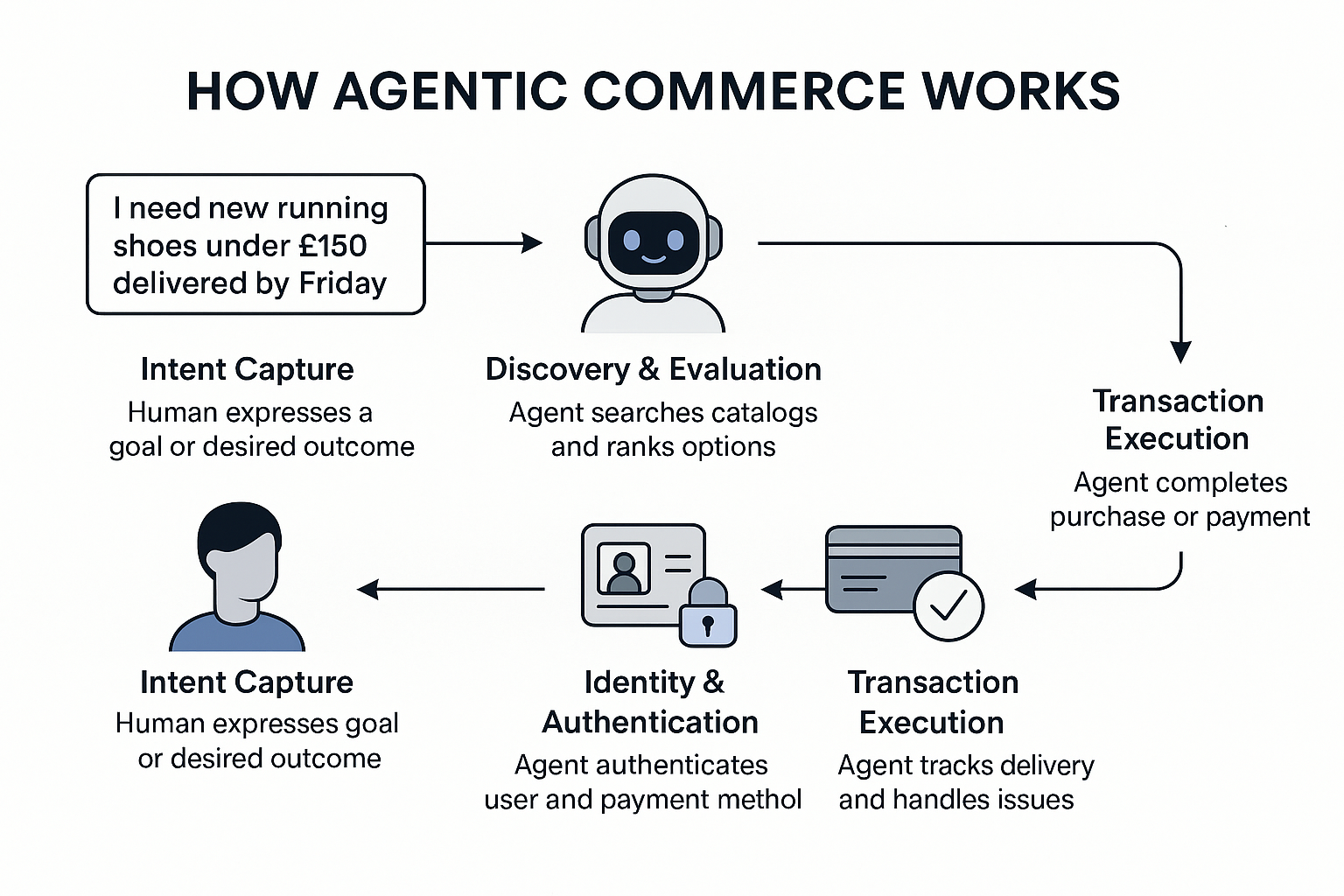
Agentic Commerce 101 for Beginners VogueBoost.com — FinTech Upskilling Series Agentic commerce is one of those shifts that sounds abstract until suddenly it feels inevitable. Much like the transition from desktop to mobile, or from cheques to instant payments, it starts with a small change in consumer expectations and then cascades into a fundamental redesign of the entire commercial stack. And as we step into 2026, it’s clear we are no longer at the “prediction” stage. The infrastructure is real, the adoption curves are rising, and both global platforms and small businesses are re‑architecting around it. To understand this shift, it helps to begin with the simplest possible framing: agentic commerce is what happens when people no longer shop — their agents do. McKinsey describes this new model as a “seismic shift,” one where AI agents don’t merely recommend products but actually anticipate needs, evaluate options, negotiate tradeoffs, and execute purchases with very little human intervention. It’s a step beyond e‑commerce, beyond chatbots, beyond “AI-powered search.” It’s a world where shopping becomes intent‑driven rather than task‑driven. A helpful way to picture it is to imagine giving a single instruction — “I need running shoes under £150 delivered by Friday” — and then stepping away. The agent interprets your intent, reviews merchant catalogs, compares prices and delivery windows, authenticates your identity, completes the transaction, and even manages the delivery or returns. As FinTech Futures notes, the key difference between agentic commerce and earlier “AI shopping assistants” is agency itself: these agents don’t just advise; they actually complete the workflow end‑to‑end. The signs are here for quite some time This shift isn’t happening in a vacuum. Over the last 24 months, we’ve seen the technical and commercial foundations assemble rapidly. Google launched its Universal Commerce Protocol in January 2026, opening a standard way for agents to interact with merchant data and perform purchases. Microsoft rolled out Copilot Checkout across the U.S. soon after. Shopify reported staggering growth — a fifteen‑fold increase — in orders initiated by AI-driven searches. Meanwhile, ChatGPT’s Agentic Commerce Protocol is now powering shopping interactions for its 900 million weekly active users. All of these developments, as nShift details, point toward a digital ecosystem that has quietly reorganized itself around machine-driven intermediaries. So what exactly is happening behind the scenes when an agent executes a purchase? The process begins with intention. Unlike legacy chatbots that respond to questions, agentic systems start with a goal: find me, decide for me, buy for me. FinTech Futures gives the simple example of a consumer specifying: “Find me shoes with blue stripes under $150,” and the agent taking responsibility for the entire subsequent workflow — discovery, evaluation, checkout, payment, even tracking. The user is no longer hunting through dozens of pages or worrying about form fields; they simply express constraints and desired outcomes. The discovery Once intent is defined, the agent begins discovery. This is where the dynamics of commerce fundamentally change. In the traditional model, discovery is mediated by scrolling, filtering, SEO, and advertising. But for an AI agent, browsing is not browsing — it’s a direct, structured sweep through inventory data, APIs, and realtime availability feeds. nShift calls the search bar “a tax on your customer’s time,” something agents remove entirely by filtering the entire commerce universe programmatically. That shift in behavior also means businesses must represent their offerings in structured, machine-readable ways or risk becoming invisible to the agents that are increasingly making purchase decisions. After the agent evaluates options, it must authenticate and transact. The mechanics here are increasingly standardized thanks to emerging interoperability frameworks. McKinsey highlights several of the major enabling protocols — the Model Context Protocol (MCP), Agent-to-Agent Protocol (A2A), Agent Payments Protocol (AP2), and Agentic Commerce Protocol (ACP). These standards together enable agents to exchange information, coordinate across systems, and, crucially, ride on the rails of existing digital commerce and payment networks. This means an agent doesn’t need a special “agent-only” checkout. It simply acts as a highly capable user moving through the same rails humans do — card payments, instant payments (RTP, SEPA Instant, Pix), bank transfers, and stablecoin rails. Once the transaction is done, the agent continues onward: tracking delivery, notifying the user, initiating returns, issuing refunds, or escalating support cases. This post‑purchase capability is especially emphasized in the newest analyses of agentic AI for SMBs, where autonomous systems can already resolve customer issues, modify shipments, send invoices, or update internal systems without human supervision. A new operating model If this sounds like an entirely new operating model, that’s because it is. And it introduces a major challenge for the market: the agentic readiness gap. As nShift explains, most retailers have spent years optimizing for discovery — SEO, ads, site design — but very few have optimized for agents that expect reliable data, trustworthy delivery, and structurally sound operational systems. Agents don’t have brand loyalty or sentiment; they evaluate merchants based on reliability signals that can be assessed instantly: delivery guarantees, stock accuracy, pricing consistency, refund policies, and frictionless integration. If a merchant’s data is poor or their fulfillment is inconsistent, the agent downranks them. Simply put: if your business isn’t machine-readable and machine-reliable, you are likely to vanish from the new purchase pathways. Beyond e‑commerce Beyond e‑commerce, the rise of agentic systems is having a transformative impact on SMB operations. The Rapid Architect report offers a vivid example: imagine walking into the office on Monday and finding your AI agent has already resolved dozens of customer inquiries, scheduled meetings, sent invoices, and flagged potential issues. This is not a hypothetical — it’s happening today. Autonomous agents represent a profound shift from passive AI tools to “executors” that complete multi-step tasks. Rather than responding to prompts, they pursue objectives. This makes them especially powerful for small teams that historically needed more staff to scale their operations. This evolution also creates new differentiation points in the market. According to BigCommerce, the platforms best positioned for this new world are those built on open, composable